AI estimate as of November 3, 2025 · verify with a professional before acting
AI-Generated · Verify before acting
Everything on this page is generated by AI for informational purposes only. AI can make mistakes — the AI may misidentify items or misattribute them (artist, maker, brand, designer, origin, era). This is not an official valuation and should not be used for insurance, sale, tax, estate, legal, or lending purposes — or any decision requiring a certified appraisal. It is not an authoritative claim about any person, brand, or rights holder — do not share or rely on it as a factual statement about a third party. Always consult qualified professionals before making financial decisions.
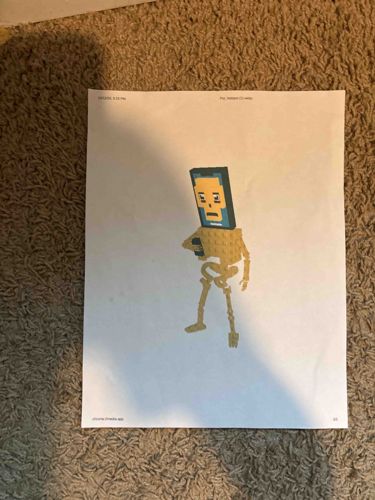
This item is a print on white paper depicting a stylized, pixel art humanoid figure, strongly reminiscent of Lego construction. The central figure is composed of blocky, pixelated forms, with a head that appears to be a dark blue or black block, featuring a yellow pixelated face with distinct eyes and a mouth. The neck and torso are constructed from yellow or tan colored 'Lego bricks,' forming a robust, somewhat rectangular, and blocky upper body. The limbs, including arms and legs, are also rendered in the same yellow/tan hue, appearing as thinner, interconnected segments suggesting joints, characteristic of a skeletal or basic humanoid form built from small blocks. The figure is positioned in a standing or slightly leaning pose, with one arm bent, possibly holding something, though the object is not clearly defined. The print itself is on standard white paper, which exhibits some minor creases or ripples, particularly visible along the bottom and right edges, suggesting it may have been handled or stored without a frame. There are also subtle shadows visible on the paper, indicating its three-dimensional presence on a textured carpet surface. Text is visible in the upper left corner, '10/21/2023, 5:10 PM', and upper right corner 'For: Jackson Coleman', suggesting it might be a date and recipient or creator. Lower left corner also shows 'chrome://media ap'. The overall aesthetic is digital art, printed, with a clear influence from pixel graphics and block-building toys like Lego. The quality of the print appears good, with crisp lines and vibrant colors for the depicted image. The estimated age is recent, given the visible date and digital nature of the artwork.
AI Appraisal Report
I have examined the provided image of what appears to be a digital art print depicting a Lego-style pixel art humanoid figure. The print itself is on standard white paper, and based on the visible creases and ripples along the edges, its condition is fair to good for a casual print, not a fine art piece. The visible date '10/21/2023, 5:10 PM' and 'For: Jackson Coleman' strongly suggest this is a recently printed, personalized digital piece, likely for personal enjoyment or a casual gift, rather than a limited edition or commercial fine art print. The 'chrome://media ap' text further supports its digital, possibly screenshot-derived origin.
Market conditions for such items are highly niche and generally low. Comparable items would include fan art prints, personalized digital art prints, or non-commercial prints of digital designs. Unless the artist of the digital artwork is of significant renown, which cannot be determined from this image alone, the value remains primarily in the cost of printing and the sentimental value to the recipient. Demand for this specific item in the broader art market would be negligible due to its generic theme and likely non-commercial origin.
Factors significantly impacting value include the lack of artist signature, edition number, or any indication of being a professionally produced art print. It appears to be an open edition print, potentially even a single-run print. Rarity, in a market sense, is not a factor here; while this specific print may be unique, the underlying digital art could be replicated.
Limitations in authenticity verification are significant. From the image alone, I cannot verify the origin of the digital art, who created it, or if it's an authorized reproduction of a known artist's work. A physical inspection would be needed to assess paper quality, print process (e.g., inkjet, laser), and definitively confirm the absence of a signature or edition marks. Provenance documentation, such as a certificate of authenticity from the artist or gallery, would be crucial for establishing any significant artistic value beyond its print cost. Without such documentation, this item is appraised primarily for its decorative value as a casual print.