AI Appraisal Estimate

AI-generated estimates · not official valuations

From the user

What was submitted

Photo and notes provided by the user — not generated by AI

Submitted item photo
Submitted photo · June 3, 2026

User's notes

No additional notes provided.

AI analysis below

AI appraisal

AI analysis & estimate

AI-Generated · Verify before acting

Everything below is generated by AI for informational purposes only. AI can make mistakes — the AI may misidentify items or misattribute them (artist, maker, brand, designer, origin, era). This is not an official valuation and should not be used for insurance, sale, tax, estate, legal, or lending purposes — or any decision requiring a certified appraisal. It is not an authoritative claim about any person, brand, or rights holder — do not share or rely on it as a factual statement about a third party. Always consult qualified professionals before making financial decisions.

Read the full disclaimer

AI Identification

·Not independently authenticated·Verify before acting

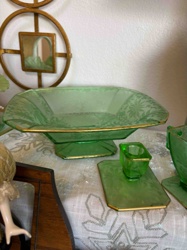
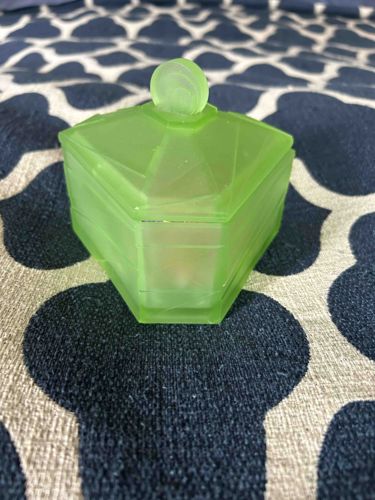
Art Deco Faceted Green Satin Glass Powder Jar

Vintage Glassware / Vanity Collectibles

AI Estimated Value

·Not an official valuation·Verify before acting

$45.00 - $65.00

As of June 3, 2026

AI Item Analysis

·AI can make mistakes·Verify before acting
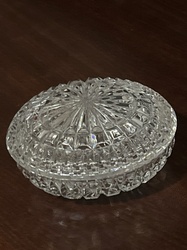
This is a vintage lidded trinket or powder jar crafted in a distinct Art Deco style. The item is made of translucent, lime-green satin (frosted) glass, a color and finish often associated with Depression-era glass or early 20th-century vanity sets. The jar features a geometric, faceted body with a hexagonal or pentagonal base tapering upwards, mirroring the sharp, clean lines characteristic of the 1920s-1930s design period. The lid is also faceted and is topped with a circular, disc-like finial that provides a functional grip. The material appears to be 'uranium glass' or 'vaseline glass' given its specific neon-green hue, which would fluoresce under ultraviolet light. The construction is molded glass with a soft, acid-etched matte finish providing the 'satin' effect. Regarding condition, there is a visible dark horizontal line or crack along one of the front facets that suggests a structural fracture or deep scratch, and minor shelf wear is evident along the base edges. No visible maker’s marks are present in the image, but the craftsmanship is consistent with European or American glassworks from the mid-20th century.
AI Appraisal Report

·AI can make mistakes·Verify before acting
I have examined the provided images of this Art Deco faceted green satin glass powder jar. The piece exemplifies the geometric sensibilities of the 1920s-1930s vanity sets, likely produced by a prominent firm such as Tiffin or Cambridge, though similar styles were widely manufactured across Europe and the US during the Depression era. The lime-green 'satin' finish is characteristic of acid-etched molded glass. Based on the visual spectrum, there is a high probability this piece contains uranium dioxide, though this can only be confirmed with a 365nm UV light source. Regarding condition, while the form remains sharp, my inspection reveals a significant horizontal fracture on a primary front facet. In the current market for Depression-era glass, condition is paramount. Collectors typically seek 'mint' examples, and structural cracks significantly devalue the item, often by 50-70%. Without this damage, the rarity of the faceted lid and the popular uranium-green hue would command a higher premium. Modern market demand for 'Vaseline glass' remains steady among niche hobbyists, but the lack of a maker's mark and the visible damage limit its investment potential. Limitations: This appraisal is based solely on digital images. A physical inspection is required to determine if the 'crack' is a structural failure or a deep surface scratch. Furthermore, I cannot verify the presence of uranium without a Geiger counter or UV test. Authentic provenance documentation or catalog matching would be necessary to elevate this from 'attributed' to a specific glasshouse. For a definitive valuation, the item should be inspected for micro-chips along the inner rim and base, which are common but often hidden in photographs.

Get your items appraised

Instant estimates of your treasures with AI-powered appraisals

Browse More Appraisals