AI estimate as of October 26, 2025 · verify with a professional before acting
AI-Generated · Verify before acting
Everything on this page is generated by AI for informational purposes only. AI can make mistakes — the AI may misidentify items or misattribute them (artist, maker, brand, designer, origin, era). This is not an official valuation and should not be used for insurance, sale, tax, estate, legal, or lending purposes — or any decision requiring a certified appraisal. It is not an authoritative claim about any person, brand, or rights holder — do not share or rely on it as a factual statement about a third party. Always consult qualified professionals before making financial decisions.
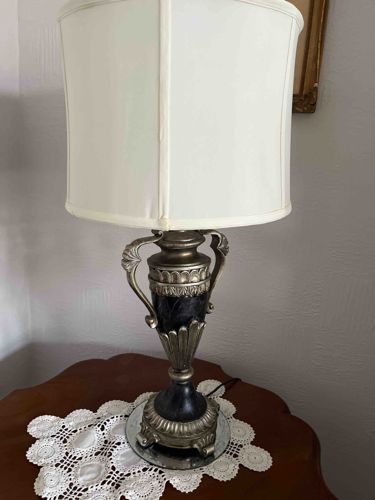
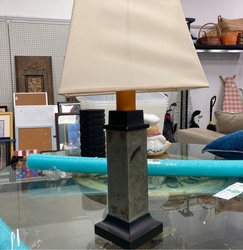
This is a decorative table lamp featuring an urn-shaped base with prominent neoclassical design elements. The base appears to be constructed from a combination of materials, likely cast metal or resin with a metallic finish, and a dark, possibly marbleized or painted, central section. The metallic portions exhibit an antique brass or bronze-like finish, showing some slight patina or darkening in recessed areas, contributing to an aged aesthetic. Notable features include elaborate, scrolled handles on either side of the urn's upper body, fluted or acanthus-leaf motifs at the base of the urn, and intricate banding with embossed patterns around the top and bottom sections of the metallic elements. The central dark section of the urn provides a stark contrast to the metallic accents, enhancing its visual appeal. The lamp rests on a circular, stepped base, which itself sits on a mirrored plate, suggesting a possible intention to enhance its presence or protect the surface it rests upon. The lamp is topped with a cream or off-white fabric drum shade, featuring vertical seams visible along its sides, indicating a structured construction. The shade appears to be in good condition, without any obvious tears or significant discoloration. The overall style suggests an influence from classical antiquity and neoclassical revival periods, possibly dating from the mid-20th century or later, designed to mimic older aesthetics. There are no clear manufacturer's marks visible in the provided image. The electrical cord is visible, indicating it is a functional electric lamp. The craftsmanship appears to be of moderate to good quality, with decorative elements that are well-defined.
AI Appraisal Report
Based on my visual examination of the Neoclassical Urn-Style Table Lamp with Fabric Shade, its condition appears to be very good. The metallic finish shows a gentle patina consistent with age or an intentional aged aesthetic, and the fabric shade seems free of tears or significant discoloration. Its authenticity as a functional electric lamp is confirmed by the visible cord. The design, with its elaborate scrolls, fluted motifs, and intricate banding, strongly evokes a Neoclassical revival style. While it mimics historical aesthetics, I suspect this piece dates from the mid-to-late 20th century, rather than being an antique, given the apparent manufacturing quality and lack of wear patterns typical of much older items. Without physical inspection, I cannot definitively confirm the material composition of the base (e.g., cast metal vs. resin), which significantly impacts value.
In terms of market conditions, Neoclassical revival lamps are generally popular for their decorative appeal but rarely command high prices unless attributed to a renowned designer or manufacturer. Comparables for similar styled, good quality reproduction lamps typically range from $100 to $300. This lamp does not exhibit unique rarity, and demand is moderate. Factors impacting value include the non-specific vintage, lack of manufacturer's marks, and what appears to be generally good, but not exceptional, craftsmanship. The mirrored plate beneath, while decorative, is likely an aesthetic choice rather than an original integrated component. For full authentication and to ascertain material composition, I would require an in-person examination to inspect manufacturer's marks, assess weight and material tactilely, and potentially analyze the electrical components for dating. Provenance documentation would also be crucial to verify any claims of designer origin or specific era.