These notes were written by the person who submitted this item. Appraiser.AI has not verified them, and the AI's identification and estimate may rely on them.
AI Estimated Value
Not an official valuation
$150-$300
AI estimate as of November 2, 2026 · verify with a professional before acting
AI-Generated · Verify before acting
Everything on this page is generated by AI for informational purposes only. AI can make mistakes — the AI may misidentify items or misattribute them (artist, maker, brand, designer, origin, era). This is not an official valuation and should not be used for insurance, sale, tax, estate, legal, or lending purposes — or any decision requiring a certified appraisal. It is not an authoritative claim about any person, brand, or rights holder — do not share or rely on it as a factual statement about a third party. Always consult qualified professionals before making financial decisions.
This analysis also relies on unverified notes provided by the user, which may be incomplete or inaccurate and could affect the result.
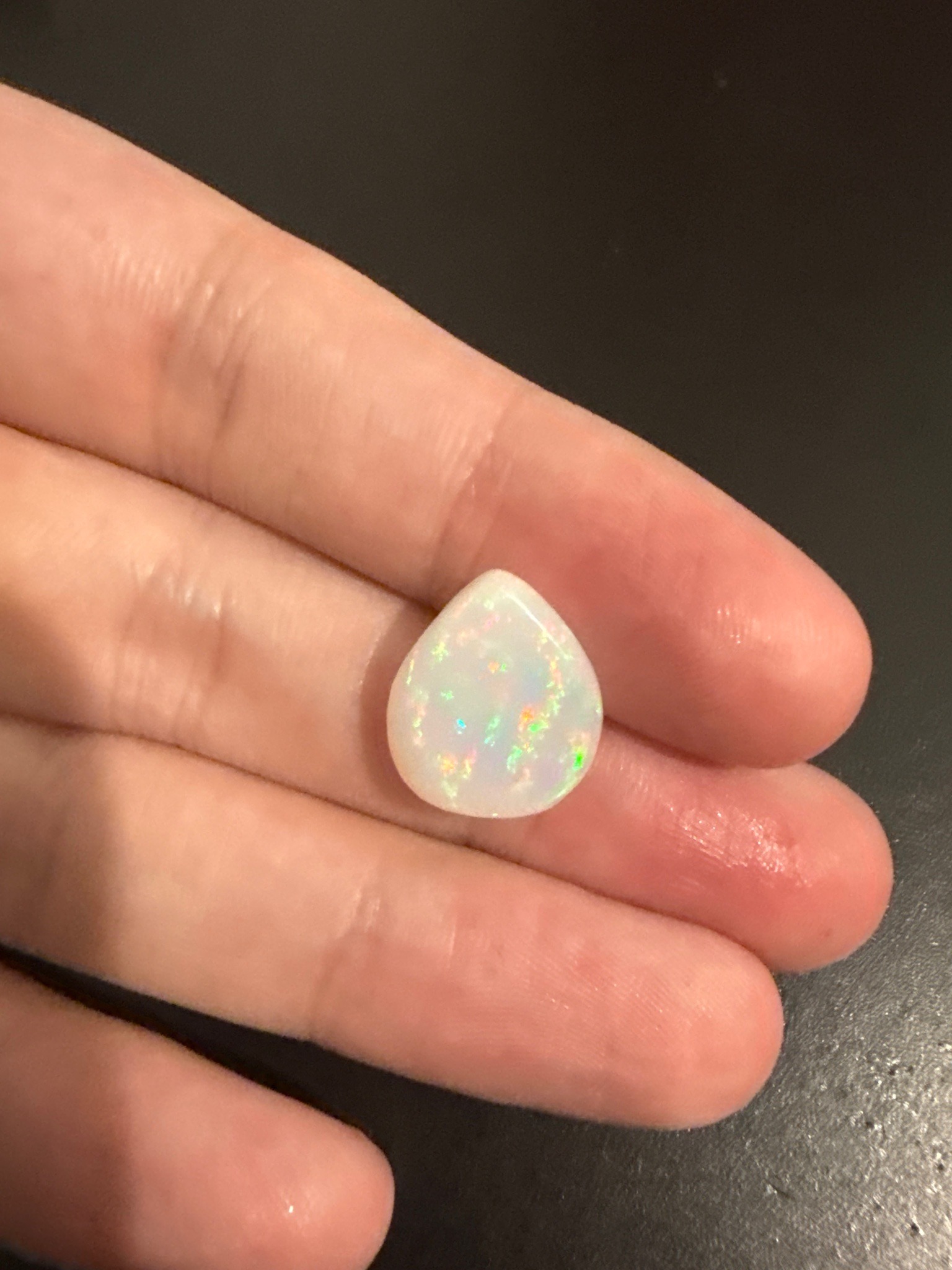
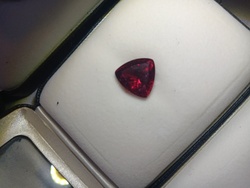
This physical item is a loose, polished gemstone cut into a teardrop or pear shape, resting on a person's fingers for scale. The stone features a predominantly whitish or translucent body tone with vibrant play-of-color, displaying flecks and flashes of green, red, orange, and blue distributed across its surface. The polish appears smooth with a domed cabochon cut, showing reflective high points under the lighting. There are no visible maker's marks, stamps, or inscriptions, as is typical for loose unmounted gemstones. The overall visual characteristics are consistent with hydrophane opal varieties, and the visual appearance aligns closely with material commonly sourced from regions such as Ethiopia, though this remains an unverified stylistic and geographical observation based solely on photographic evidence. The owner's notes identify this as an Ethiopian Opal, which is an unverified user-supplied claim. The stone appears to be in clean condition with no immediately obvious fractures or surface chips visible in the image, though microscopic inspection would be required to assess structural integrity. The identification rests entirely on optical characteristics such as body color and play-of-color pattern, without the benefit of gemological testing equipment to rule out synthetics, treatments, or alternative geographical origins.
AI Appraisal Report
Based on what I can see in the provided image, this is a loose, polished gemstone with a teardrop or pear-shaped cabochon cut, displaying a whitish body tone and a vibrant play-of-color featuring green, red, orange, and blue flashes. The owner identifies this as an Ethiopian Opal, which remains an unverified user-supplied claim. From a photograph, I can observe the optical characteristics and surface polish, but I can't verify from a photo whether the stone is entirely natural, treated, or synthetic, nor can I determine its precise geographical origin. Physical and gemological inspection would be needed to confirm these factors and structural integrity. Assuming the user's claim regarding an Ethiopian opal origin is correct, loose opals of this size, shape, and optical vibrancy typically command a modest retail market value in the $150 to $300 range, depending on weight, brilliance, and overall quality. General market demand for colorful play-of-color cabochons remains steady among jewelry designers and collectors. However, if the item turns out to be a synthetic laboratory-created opal or a glass imitation rather than a natural gemstone, the value would decrease significantly to a nominal amount, likely under $30. To establish the true nature, origin, and market value with certainty, this gemstone would require in-person examination and gemological testing by a qualified professional.