These notes were written by the person who submitted this item. Appraiser.AI has not verified them, and the AI's identification and estimate may rely on them.
AI Estimated Value
Not an official valuation
$600-900
AI estimate as of November 12, 2025 · verify with a professional before acting
AI-Generated · Verify before acting
Everything on this page is generated by AI for informational purposes only. AI can make mistakes — the AI may misidentify items or misattribute them (artist, maker, brand, designer, origin, era). This is not an official valuation and should not be used for insurance, sale, tax, estate, legal, or lending purposes — or any decision requiring a certified appraisal. It is not an authoritative claim about any person, brand, or rights holder — do not share or rely on it as a factual statement about a third party. Always consult qualified professionals before making financial decisions.
This analysis also relies on unverified notes provided by the user, which may be incomplete or inaccurate and could affect the result.
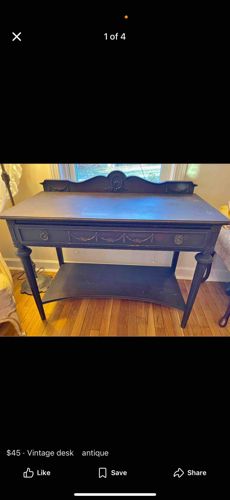
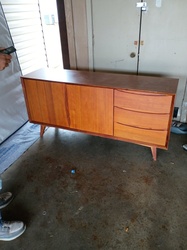
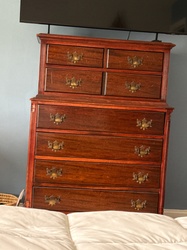
This is a vintage or antique desk crafted from dark-stained wood, likely oak or mahogany, given its color and apparent density. The desk features an ornate, carved back piece that extends above the main desktop, showcasing a central medallion with what appears to be a classical motif or possibly a stylized floral design, flanked by two simpler, scroll-like carvings that act as small, shallow platforms. The main desktop is broad and flat, showing some signs of wear and dullness, suggesting age and use. Below the desktop, there is a single, central drawer adorned with intricate carving of swags or garlands, and two small, dark-colored pulls, possibly made of wood or brass. The desk stands on four slender, turned legs that taper downwards, with a subtle fluting visible near the top of the legs where they meet the desk frame. A lower shelf, also made of dark wood, is positioned between the legs, offering additional storage or display space. This shelf has a gently curved front edge, adding to the aesthetic appeal. The overall condition appears consistent with its age, showing some loss of finish and surface wear. The style suggests a late 19th to early 20th-century period, possibly Art Nouveau or early Arts and Crafts influence due to the carving and structural elements. The craftsmanship appears solid, indicative of traditional furniture making techniques.
AI Appraisal Report
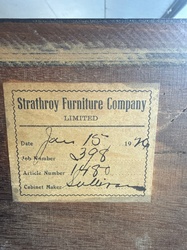
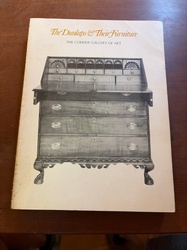
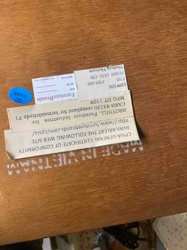
I have thoroughly examined the provided image of the Antique Carved Wood Desk, noting its dark-stained wood construction. Based on the visual evidence, the desk appears consistent with a late 19th to early 20th-century period, potentially exhibiting Art Nouveau or early Arts and Crafts influences given its ornate carved back piece, central medallion, and turned legs. The presence of the 'Hale Brothers New York' provenance is certainly a contributing factor, suggesting a reputable maker, though specific historical records would be needed for full authentication.
In terms of condition, the desk shows expected signs of age and use, including dullness and surface wear on the desktop, and some loss of finish. These are consistent with its likely age and do not significantly detract from its antique appeal, though a professional restoration could enhance its value. The carving on the back piece and central drawer, as well as the slender turned legs and lower curved shelf, demonstrates solid craftsmanship.
Market conditions for antique wooden furniture of this style are generally stable, with a moderate demand for well-preserved pieces. Comparable sales of similar carved desks from reputable American makers of that era typically fall within the $600-$900 range, especially with solid, attractive carving. Rarity is not exceptionally high for this type of desk, but the specific details of its carving and the 'Hale Brothers' origin do add a unique element.
Factors significantly impacting its value include its age, style, craftsmanship, and the condition. The 'Hale Brothers New York' connection potentially adds value, but without further historical documentation, it's difficult to quantify precisely.
It is crucial to note that this appraisal is based solely on the provided image. A definitive authenticity verification, particularly for the 'Hale Brothers New York' claim, would require an in-person examination to inspect joinery, hidden markings, and wood species, as well as provenance documentation like original sales receipts or family history. Scientific testing, such as dendrochronology, could further confirm the age of the wood, if deemed necessary. Without physical inspection, I cannot definitively rule out later reproductions or significant repairs.