These notes were written by the person who submitted this item. Appraiser.AI has not verified them, and the AI's identification and estimate may rely on them.
AI Estimated Value
Not an official valuation
$15-30
AI estimate as of July 1, 2025 · verify with a professional before acting
AI-Generated · Verify before acting
Everything on this page is generated by AI for informational purposes only. AI can make mistakes — the AI may misidentify items or misattribute them (artist, maker, brand, designer, origin, era). This is not an official valuation and should not be used for insurance, sale, tax, estate, legal, or lending purposes — or any decision requiring a certified appraisal. It is not an authoritative claim about any person, brand, or rights holder — do not share or rely on it as a factual statement about a third party. Always consult qualified professionals before making financial decisions.
This analysis also relies on unverified notes provided by the user, which may be incomplete or inaccurate and could affect the result.
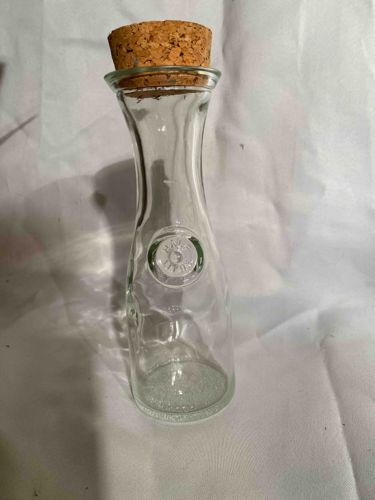
This item is a clear glass carafe or decanter, designed for serving liquids, specifically wine as indicated by the context. It features a graceful, subtly hourglass-shaped body that tapers inward towards the middle before flaring out slightly again. The neck of the carafe is relatively wide, accommodating a natural cork stopper, which appears to be in good condition, showing typical cork texture and natural color variations. The glass itself is transparent, allowing for full visibility of the contents. On the front of the carafe, near the upper portion of its body, there is an embossed circular medallion. While difficult to decipher precisely from the image, this medallion likely contains a manufacturer's mark, a logo, or perhaps a capacity indication. Below this, there are subtle molded lines or indicators that could denote measurement increments, though they are not clearly readable. The base is flat and relatively thick, providing stability. The overall craftsmanship appears to be of standard quality for mass-produced glassware, with no obvious major flaws or high-end artistic flourishes. Given the context provided, suggesting it is a 'Half Litre wine carafe from the 1800s,' if truly from that period, it would possess a significant patina, though the glass appears quite clear and modern in its presentation, suggesting it might be a reproduction or a more contemporary piece designed in an antique style. Visible condition is good; the glass is clear, and the cork fits well. There are no apparent chips, cracks, or significant scratches visible on the glass, maintaining its transparency and reflective quality. The bottom rim also appears clean and intact.
AI Appraisal Report
Upon visual examination of the provided image, I have assessed this half-litre glass wine carafe with its cork stopper. The owner's claim suggests a 19th-century origin. However, the glass exhibits a clarity, uniformity, and modern-style pressed medallion characteristic of 20th-century, or even more recent, mass production techniques. Antique glass from the 1800s typically shows imperfections like pontil marks on the base, seeds (trapped air bubbles), waviness, or a slight off-color tint, none of which are apparent here. The overall condition appears to be very good, with no visible chips or cracks. While the design is classic, it is not particularly rare. The market for such items is primarily decorative or for practical use rather than for serious antique collecting. Similar mid-to-late 20th-century European bistro-style carafes are quite common and readily available. The primary factor depressing the value is the high likelihood that this is not an antique from the 1800s. Its value is based on its utility and decorative appeal as a vintage-style piece. A definitive assessment of age and origin is limited by the image-only examination. A physical inspection would be required to search for a pontil mark, analyze the glass composition and weight, and examine the maker's mark on the medallion for positive identification. Without such verification or provenance, I must appraise it as a 20th-century reproduction or vintage-style item.