AI estimate as of June 29, 2025 · verify with a professional before acting
AI-Generated · Verify before acting
Everything on this page is generated by AI for informational purposes only. AI can make mistakes — the AI may misidentify items or misattribute them (artist, maker, brand, designer, origin, era). This is not an official valuation and should not be used for insurance, sale, tax, estate, legal, or lending purposes — or any decision requiring a certified appraisal. It is not an authoritative claim about any person, brand, or rights holder — do not share or rely on it as a factual statement about a third party. Always consult qualified professionals before making financial decisions.
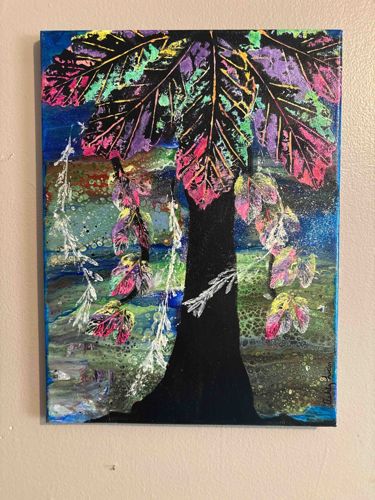
This is an upright rectangular painting, appearing to be crafted with acrylic paints on stretched canvas. The central motif is a stylized tree with a bold, opaque black trunk occupying the lower two-thirds of the canvas. Above the trunk, expansive leaves dominate the upper portion, rendered in a striking array of vivid hues including fuchsia, purple, teal, lime green, and bright yellow. These large leaves display prominent vein patterns, outlined in black, strongly suggesting they were created using a leaf-printing or stenciling technique, giving them a distinct texture and depth. Below these main leaves, smaller, similarly colored leaves appear to cascade downwards, some seemingly attached to white, wispy elements that could represent delicate branches, vines, or even falling rain/snow. The background is a complex, multi-layered composition indicative of a fluid art or paint pouring technique. It features dynamic swirls and pools of blues, greens, browns, and whites, creating a variegated, abstract landscape that evokes a sense of water, earth, and sky. The interaction of the fluid paints has resulted in organic transitions and cell-like formations, contributing to the painting's abstract and modern nature. The overall impression is one of vibrant energy and imaginative natural representation. The painting appears to be in excellent condition, with no discernible damage such as scratches, tears, or fading visible from the image. No artist's signature or specific manufacturing marks are apparent from the provided view, which is common for contemporary decorative art pieces. The modern aesthetic and use of fluid art techniques suggest a production date likely within the 21st century. The unique blend of structured leaf impressions with the organic, uncontrolled beauty of fluid art creates a visually captivating and decorative piece of craftsmanship, suitable for contemporary interior decor.
AI Appraisal Report
Based on my visual examination of the provided imagery, this upright rectangular acrylic painting on stretched canvas appears to be in excellent condition. There are no discernible scratches, tears, or fading, indicating careful preservation. The skilled use of fluid art for the dynamic background, combined with what appears to be a leaf-printing or stenciling technique for the central tree motif, suggests an original work with appealing craftsmanship.
However, the absence of a visible artist's signature or specific manufacturing marks from this remote view prevents definitive authentication of its authorship or unique provenance. My assessment of its originality relies on the apparent brushwork and technique consistency. A physical inspection would be crucial to confirm material integrity, subtle surface textures, and to rule out a high-quality reproduction. Provenance documentation, such as purchase records, would further establish its history and potential artist.
The market for contemporary decorative abstract art, especially pieces employing popular fluid art techniques, shows consistent demand for interior design. Works of this nature, often by unknown or emerging artists, command value based primarily on aesthetic appeal, size, and condition. While not exceptionally rare in its general style, its uniqueness lies in its specific artistic execution.
The value is positively influenced by its vibrant aesthetic, excellent condition, and suitability for modern decor. Conversely, the lack of an identifiable artist or provenance limits its investment value beyond its decorative merit. This places it firmly within the realm of contemporary decorative art rather than fine art with established market history.