AI estimate as of November 4, 2025 · verify with a professional before acting
AI-Generated · Verify before acting
Everything on this page is generated by AI for informational purposes only. AI can make mistakes — the AI may misidentify items or misattribute them (artist, maker, brand, designer, origin, era). This is not an official valuation and should not be used for insurance, sale, tax, estate, legal, or lending purposes — or any decision requiring a certified appraisal. It is not an authoritative claim about any person, brand, or rights holder — do not share or rely on it as a factual statement about a third party. Always consult qualified professionals before making financial decisions.
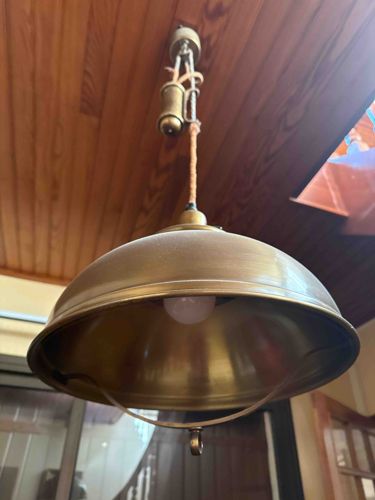
This item is a vintage-style pendant light fixture, predominantly crafted from brass or a brass-toned metal, featuring a classic dome-shaped shade. The metal exhibits a warm, golden hue with a visible aged patina, indicating some oxidization and dust accumulation, specifically noticeable on the exterior of the shade and the suspension mechanism. The shade itself is a substantial, wide-brimmed dome, with a visible rolled or flanged edge at the top where it attaches to the suspension, and a smooth, polished or brushed finish on both its exterior and interior reflective surface. The interior appears slightly shinier, aiding in light reflection. The suspension system consists of several brass components, including a ceiling canopy (partially visible), a decorative cylindrical element, and what appears to be a wrapped or braided cord (possibly electrical wiring encased in a textile sleeve) leading down to the shade. There's an additional, smaller brass element, possibly a counterweight or an adjustable mechanism, situated above the main shade. A thin, circular wire or rod, likely for stabilization or decorative effect, is attached to the rim of the shade, ending in a small loop or hook at its lowest point. The light source is a single, exposed incandescent-style bulb, clearly visible within the shade. The overall aesthetic suggests an industrial, farmhouse, or rustic design, likely from the mid-20th century or a reproduction of that era. There are no obvious signs of severe damage such as dents or significant scratches, but routine cleaning would improve its appearance. The quality of craftsmanship appears solid, emphasizing durability and a utilitarian yet decorative function. The assembly suggests it might be an adjustable-height fixture, given the visible cord routing.
AI Appraisal Report
I have visually examined this Vintage Brass Pendant Light Fixture. Based on the provided image, the item appears to be a vintage-style pendant light, likely from the mid-20th century or a high-quality reproduction. The brass-toned metal exhibits a warm patina consistent with age and some oxidization, which enhances its vintage appeal rather than detracting from it. The condition is generally good; I do not observe any significant dents, cracks, or severe damage that would impact its functionality or aesthetic value, though routine cleaning would certainly improve its presentation. The exposed incandescent-style bulb further supports its vintage or retro aesthetic.
From a market perspective, there is consistent demand for lighting fixtures of this industrial, farmhouse, and rustic design. Dome-shaped brass pendants are popular in various interior design schemes. While not exceptionally rare, authentic vintage pieces in good working order fetch higher prices than mass-produced reproductions. The apparent solid craftsmanship and completeness of the fixture (including suspension parts) are positive factors.
Factors impacting value include its age, material quality, and design aesthetics. The presence of a substantial, well-proportioned dome shade and complete suspension system adds to its desirability. If it is genuinely vintage, its value is higher than a modern reproduction. The main limitation in determining authenticity and full value from an image alone is the inability to physically inspect the materials, construction methods, and internal wiring. An in-person examination would allow me to determine if the brass is solid or plated, assess the quality of the electrical components, and look for manufacturer's marks or labels. Provenance documentation (such as original purchase receipts or maker's marks) would be crucial for full authentication. Without such verification, it is difficult to differentiate definitively between a true antique and a well-made vintage-style reproduction. For this appraisal, I am assuming it is either a well-preserved vintage piece or a high-quality reproduction given the apparent craftsmanship.