These notes were written by the person who submitted this item. Appraiser.AI has not verified them, and the AI's identification and estimate may rely on them.
AI Estimated Value
Not an official valuation
$0.50 - $1.50
AI estimate as of November 30, 2025 · verify with a professional before acting
AI-Generated · Verify before acting
Everything on this page is generated by AI for informational purposes only. AI can make mistakes — the AI may misidentify items or misattribute them (artist, maker, brand, designer, origin, era). This is not an official valuation and should not be used for insurance, sale, tax, estate, legal, or lending purposes — or any decision requiring a certified appraisal. It is not an authoritative claim about any person, brand, or rights holder — do not share or rely on it as a factual statement about a third party. Always consult qualified professionals before making financial decisions.
This analysis also relies on unverified notes provided by the user, which may be incomplete or inaccurate and could affect the result.
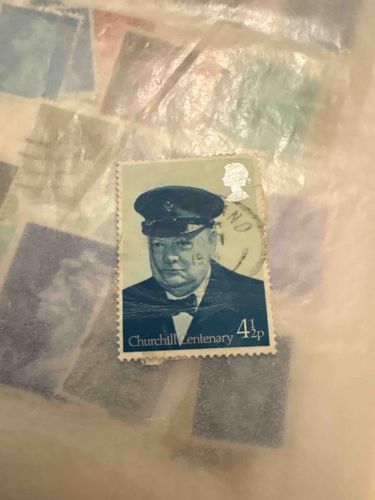
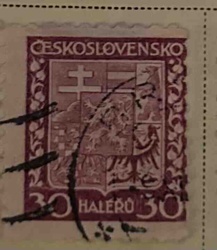
This item is a postage stamp from Great Britain commemorating the Churchill Centenary, likely issued in 1974. The stamp features a portrait of Winston Churchill in what appears to be a naval or military uniform cap, with a tie or bow tie. The dominant color of the portrait and textual elements is a deep blue, printed on a cream or light tan background, which encompasses the visible portion of Churchill's head and upper torso. The stamp has perforated edges, typical for postage stamps, suggesting it was originally part of a sheet. In the upper right corner, the silhouette of Queen Elizabeth II, a common feature on British stamps, is visible in white. Below Churchill's portrait, the inscription 'Churchill Centenary' is clearly legible in white lettering against the blue background, along with the denomination '4 1/2p' (four and a half pence). The stamp appears to be uncancelled, as no obvious ink marks or postmarks are evident across the portrait. There are signs of possible aging or handling, including a slight yellowing or discoloration of the paper and a small, faint, circular mark to the right of Churchill's head, which might be a partial postmark or a stain from an old hinge. The overall condition, while exhibiting some minor imperfections, suggests it has been preserved, possibly in a collection. The craftsmanship is typical of national postal services, involving lithographic or intaglio printing on paper.
AI Appraisal Report
I have examined the provided image of the Great Britain 1974 Churchill Centenary 4 1/2p stamp. This stamp commemorates Winston Churchill and features his portrait, the denomination, and the silhouette of Queen Elizabeth II, consistent with Royal Mail issues of the period. The dominant deep blue on a cream background is typical for this specific stamp. I note the perforated edges, indicating it was part of a larger sheet. My visual assessment suggests the stamp is uncancelled, which is a positive factor for collectors, as there are no obvious postmarks obscuring the design.
However, I observe several condition issues. There is a slight yellowing or discoloration of the paper, consistent with aging, and a small, faint, circular mark to the right of Churchill's head. This mark could be a partial postmark, a hinge remnant, or a stain, and it detracts from the stamp's pristine appearance. While suggesting preservation, these imperfections reduce its value compared to a perfectly mint example. Authenticity, based solely on the image, appears to be consistent with a genuine 1974 Churchill Centenary stamp. The design elements and printing characteristics align with known examples.
Regarding market conditions, this is a relatively common commemorative stamp from a modern era (post-1950s). Such stamps were produced in large quantities and are readily available on the philatelic market. There is a steady but generally low demand for common, uncancelled examples in less-than-perfect condition. Rarity is not a significant factor here; these are not scarce issues. Factors impacting value are primarily condition and availability. A truly mint, never-hinged example without any flaws might fetch slightly more, but the visible imperfections on this specimen limit its upper-end value.
Crucially, my assessment is based solely on a singular image. For a definitive appraisal and authentication, a physical, in-person examination is essential. This would allow me to accurately assess paper quality, gum condition (if present on the reverse), exact color fidelity, determine the nature of the circular mark, and confirm the absence of hidden faults or repairs not visible in the image. Provenance documentation, such as where and when the stamp was acquired, could also provide additional layers of authentication, though for a common modern stamp like this, it's less critical than for genuinely rare items.