These notes were written by the person who submitted this item. Appraiser.AI has not verified them, and the AI's identification and estimate may rely on them.
AI Estimated Value
Not an official valuation
$300-500
AI estimate as of August 23, 2025 · verify with a professional before acting
AI-Generated · Verify before acting
Everything on this page is generated by AI for informational purposes only. AI can make mistakes — the AI may misidentify items or misattribute them (artist, maker, brand, designer, origin, era). This is not an official valuation and should not be used for insurance, sale, tax, estate, legal, or lending purposes — or any decision requiring a certified appraisal. It is not an authoritative claim about any person, brand, or rights holder — do not share or rely on it as a factual statement about a third party. Always consult qualified professionals before making financial decisions.
This analysis also relies on unverified notes provided by the user, which may be incomplete or inaccurate and could affect the result.
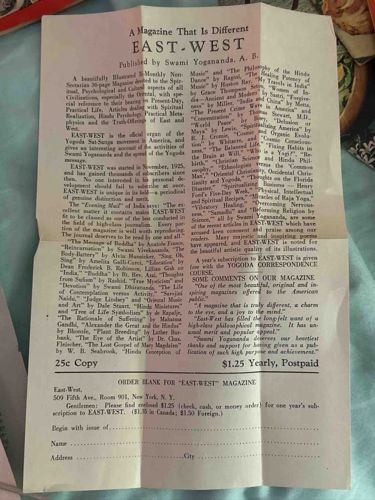
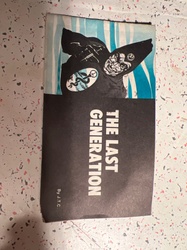
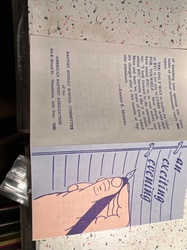
This item is a promotional flyer or order blank for the 'EAST-WEST' magazine, published by Swami Yogananda, A.B. It is printed on light-colored paper, likely an off-white or cream, showing signs of age with some discoloration and creasing, particularly a prominent vertical fold down the center and horizontal folds across the middle, suggesting it was once folded for mailing or storage. The overall condition appears to be fair to good for its age, with no apparent tears or major damage beyond the expected wear for paper ephemera. The text, printed in black ink, is clearly legible, featuring a combination of larger sans-serif font for the title and smaller serif font for the body copy. The document details the magazine's content, which focuses on spiritual, philosophical, and cultural aspects, presented as 'A Magazine That is Different.' It highlights Swami Yogananda as the publisher and mentions its origin in November 1925, indicating an estimated age of 1926 based on the provided context of '1926 yogoda ephemera.' The flyer also includes a list of article titles and authors featured in the magazine, comments from readers, subscription prices (25 cents per copy, $1.25 yearly postpaid), and an order blank with space for name, address, and city for subscriptions to be sent to 509 Fifth Ave., Room 901, New York, N.Y. This piece serves as a significant historical artifact, connecting to the early dissemination of Yogoda (later Self-Realization Fellowship) teachings in the Western world.
AI Appraisal Report
I have carefully examined the provided image of the 'EAST-WEST' magazine promotional flyer/order blank, identified as 1926 Yogoda ephemera. From the visual evidence, the item appears to be authentic to the period, consistent with printing methods and paper quality of the mid-1920s. The text is clear and the design aligns with typical promotional materials of early spiritual movements. The condition, characterized by discoloration, significant vertical and horizontal creasing from folding, and apparent age-related wear, is fair to good for a piece of paper ephemera nearing a century old. There are no visible tears or major losses, which is positive for its preservation.
Market conditions for early Yogoda/Self-Realization Fellowship ephemera are relatively stable with consistent, albeit specialized, demand. Pieces directly related to Swami Yogananda from his early years in the West are particularly sought after by collectors of spiritual history, new religious movements, and followers of his teachings. The rarity of such specific promotional flyers from 1926 is moderate; while not unique, they are not commonly found in excellent condition. This item's primary value stems from its direct connection to the foundational period of 'EAST-WEST' magazine, an important platform for Yogananda's teachings, making it a significant historical artifact.
Factors significantly impacting its value include its age, clear legibility, and its association with Swami Yogananda and the early dissemination of his work. The creasing, while extensive, is indicative of its use and age rather than damage, and does not severely detract from its appeal. Limitations in authenticity verification from images alone include confirming paper stock, ink type, and detecting any modern repairs or reproductions. For full authentication, I would require a physical examination to assess paper acidity, fiber content, and ink characteristics under magnification, and to check for any hidden repairs or restorations. Provenance documentation, such as collection history, would also be beneficial but is often unavailable for such historical ephemera.