AI estimate as of September 22, 2025 · verify with a professional before acting
AI-Generated · Verify before acting
Everything on this page is generated by AI for informational purposes only. AI can make mistakes — the AI may misidentify items or misattribute them (artist, maker, brand, designer, origin, era). This is not an official valuation and should not be used for insurance, sale, tax, estate, legal, or lending purposes — or any decision requiring a certified appraisal. It is not an authoritative claim about any person, brand, or rights holder — do not share or rely on it as a factual statement about a third party. Always consult qualified professionals before making financial decisions.
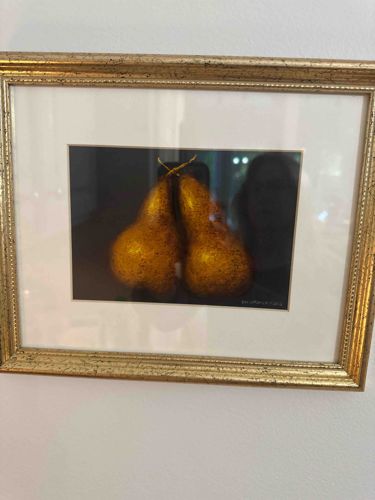
This item is a framed still life print depicting two golden-hued pears against a dark, possibly black or very deep gray, background. The pears appear to be nestled closely together, with their stems intertwined at the top, suggesting a sense of intimacy or connection. Their surfaces exhibit a mottled texture, possibly indicating fine speckles or subtle variations in color, which contributes to a realistic appearance. The overall color palette of the print centers around warm yellow and orange tones for the pears, contrasting sharply with the dark background to create a dramatic effect. The print is housed within a substantial gold-colored frame, which features an ornate, possibly carved or molded, relief pattern along its inner and outer edges, giving it a classic or traditional aesthetic. The gold finish of the frame has a somewhat distressed or antiqued appearance, showing variations in tone and texture that mimic age and wear, though this could be an intentional design choice. Between the print and the frame is a wide, off-white or cream-colored matboard, providing visual separation and enhancing the artwork's presentation. The visible surface of the print is protected by a sheet of glass or acrylic, which reflects some ambient light, indicating its presence. A faint signature or inscription is visible in the bottom right corner of the print, suggesting it is a signed piece, though the details are not discernible from the image. The framing appears professional, and the piece seems to be in good overall condition, with no overt damage to the frame, mat, or print discernable. The style leans towards traditional still life photography or painting reproductions, likely from the late 20th or early 21st century.
AI Appraisal Report
I have examined the provided image of this framed still life print depicting two pears. Visually, the print appears to be in good overall condition, with no obvious damage to the print itself, the mat, or the ornate gold-colored frame, which exhibits an intentional antiqued finish. The professional framing, including a matboard and protective glass, enhances its presentation. Authenticity based solely on this image is limited; while a faint signature is noted, it is illegible, making attribution impossible without a clear image or in-person inspection. Without identifying the artist, print medium (e.g., giclée, offset lithograph, photograph), and edition size (if applicable), establishing true authenticity and provenance is challenging. The print's aesthetic aligns with conventional decorative art, likely mass-produced in the late 20th or early 21st century. Market conditions for unsigned or unattributed decorative still life prints are generally modest. Comparable items, even with quality framing, typically retail in the $50-$150 range. Demand for such pieces is steady among buyers looking for affordable decorative art rather than investment pieces. Rarity is unlikely given the probable production methods. Factors impacting value negatively include the unknown artist and the mass-market nature. A higher value would depend on identifying a recognized artist or a rare print medium. A physical examination could identify print type, artist details, and confirm condition, while provenance documentation or scientific testing would be essential for full authenticity and a more precise valuation.