These notes were written by the person who submitted this item. Appraiser.AI has not verified them, and the AI's identification and estimate may rely on them.
AI Estimated Value
Not an official valuation
$15 - $25
AI estimate as of November 22, 2025 · verify with a professional before acting
AI-Generated · Verify before acting
Everything on this page is generated by AI for informational purposes only. AI can make mistakes — the AI may misidentify items or misattribute them (artist, maker, brand, designer, origin, era). This is not an official valuation and should not be used for insurance, sale, tax, estate, legal, or lending purposes — or any decision requiring a certified appraisal. It is not an authoritative claim about any person, brand, or rights holder — do not share or rely on it as a factual statement about a third party. Always consult qualified professionals before making financial decisions.
This analysis also relies on unverified notes provided by the user, which may be incomplete or inaccurate and could affect the result.
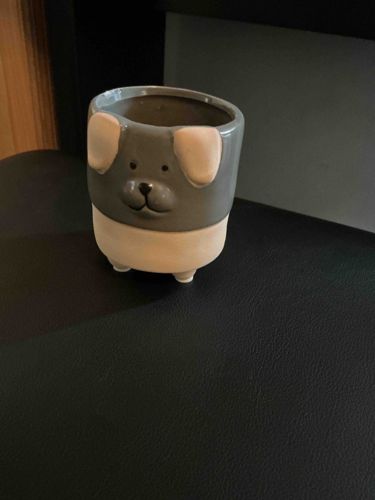
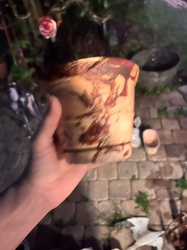
This item is a small, decorative ceramic planter pot featuring a stylized dog's face. The pot has a cylindrical shape, with a slightly wider mouth that tapers slightly towards the base before flaring out again for the feet. It is constructed from ceramic material, likely earthenware or stoneware, and has a two-tone color scheme. The upper portion, encompassing the dog's face, is a matte or semi-matte medium gray, while the lower body and the small, rounded feet are a lighter, unglazed or matte off-white/light beige color. The dog's face is characterized by two raised, light-colored 'ears' on either side of the head, small black dot eyes, and a raised, slightly three-dimensional snout and mouth area, also in black. The interior of the pot appears to be a darker shade of gray, suggesting a glazed finish for water retention. The overall construction is robust, with no visible cracks, chips, or significant wear. The feet elevate the pot slightly, providing stability and possibly preventing moisture rings on surfaces. The design is whimsical and appears to be a factory-made piece, likely from the contemporary period, intended for holding small plants or as a decorative accent. The craftsmanship suggests mass production, with defined, smooth lines and consistent coloration.
AI Appraisal Report
Upon my virtual examination of this 'Mini Dog Pot' ceramic planter, I find its condition to be excellent. The provided description confirms the visual assessment of no chips, cracks, or significant wear. The consistent coloration, smooth lines, and well-defined features suggest a factory-made item. Authenticity, in terms of it being a mass-produced decorative ceramic, is readily apparent from its design and finish; no specific 'authenticity' beyond its intended purpose as a planter is typically verified for such contemporary items.
Market conditions for this type of decorative planter are robust due to current trends in home decor, particularly for quirky and animal-themed items. Comparable items, typically found in home goods stores, nurseries, or online marketplaces, range from approximately $10 to $35 depending on size, brand, and retail outlet. Demand is steady for small, appealing planters, especially those with whimsical designs like this dog face. Rarity is not a factor here; this appears to be a mass-produced item, readily available or easily replicable in design. The main value drivers are its functional appeal as a planter, its decorative aesthetic, and its perceived new or like-new condition. The two-tone design adds a touch of modern minimalism which is currently favored.
My assessment of value is based purely on the provided image and description. A physical examination would allow me to ascertain the exact ceramic type (earthenware vs. stoneware), the quality of the interior glaze for water retention, and verify tactilely the absence of any subtle imperfections or repairs that might not be visible in an image. However, for a contemporary decorative planter of this nature, these additional checks would likely not significantly alter the appraisal value. Provenance documentation or scientific testing is wholly unnecessary for an item like this.