AI estimate as of October 7, 2025 · verify with a professional before acting
AI-Generated · Verify before acting
Everything on this page is generated by AI for informational purposes only. AI can make mistakes — the AI may misidentify items or misattribute them (artist, maker, brand, designer, origin, era). This is not an official valuation and should not be used for insurance, sale, tax, estate, legal, or lending purposes — or any decision requiring a certified appraisal. It is not an authoritative claim about any person, brand, or rights holder — do not share or rely on it as a factual statement about a third party. Always consult qualified professionals before making financial decisions.
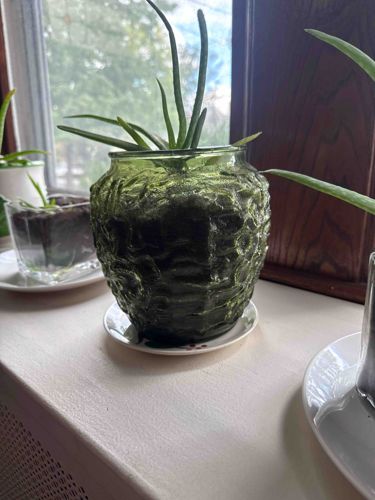
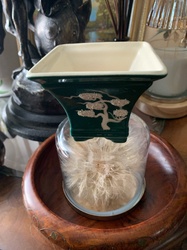
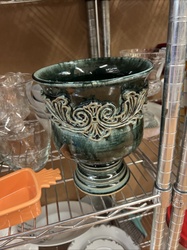
This item is an embossed green glass planter, currently housing an aloe-like succulent plant. The planter is characterized by its deep emerald green transparency, allowing light to partially filter through while obscuring the soil within. Its shape is a squatted, rounded vase or pot style, with a slightly flared rim at the top opening. The most distinctive feature is the heavily textured, embossed surface, which appears to mimic a rough, hammered, or possibly organic, bark-like pattern. This texture creates a tactile and visually interesting surface, diffusing reflections and adding depth to the glass. The glass construction suggests a molded manufacturing process, likely machine-made, given the uniformity of the embossing across the surface, although without closer inspection or maker's marks, a hand-blown origin cannot be entirely ruled out. The overall condition appears good, with no visible cracks, chips, or significant damage to the glass itself. There might be some minor surface dust or residue, but it does not appear to affect the structural integrity or aesthetic appeal. The planter rests on a small, white ceramic saucer with a subtle floral or decorative trim, suggesting an intent to catch excess water and protect the surface it sits upon. The style points towards mid-20th century or later, possibly reflecting a vintage or retro aesthetic that has seen a resurgence in popularity. The plant itself features several upright, narrow, and fleshy green leaves, consistent with a variety of succulent such as an Aloe vera or similar species. The combination of the textured green glass and the living plant creates a natural and decorative aesthetic, suitable for home decor.
AI Appraisal Report
Based on my visual examination of the provided image, this Embossed Green Glass Planter with an aloe-like plant appears to be in very good overall condition. I observe no visible cracks, chips, or significant damage to the glass itself, which retains its deep emerald green transparency. The embossed, textured surface is intact and contributes significantly to its decorative appeal. The authenticity of the glass as molded, likely machine-made, is strongly suggested by the uniformity of the embossing, though without direct physical handling, I cannot definitively rule out a hand-blown origin. The accompanying ceramic saucer is a functional addition, maintaining the item's integrity as a planter.
Market conditions for decorative glass planters of this type, especially those with a mid-20th century or retro aesthetic, are generally stable. Comparable items, often found in vintage shops or online marketplaces, typically fall within a modest price range. Demand is decent for attractive and functional pieces for home decor, but rarity is not a significant factor here; embossed glass planters, while varied in design, are not uncommon. Factors impacting value are primarily aesthetic appeal, condition, and current trends in home decor. The plant itself, while adding to the visual presentation, does not significantly contribute to the intrinsic value of the planter itself.
My primary limitation in authentication and valuation is the reliance on images alone. To fully authenticate the manufacturing process (hand-blown vs. machine-made) and assess the precise age and potential maker (though no marks are visible), a thorough in-person examination would be necessary. This would involve inspecting seams, pontil marks (if any), and any subtle variations that distinguish artisanal pieces from mass-produced ones. Without provenance documentation or scientific testing to pinpoint exact origins or materials, the valuation remains an estimate based on visual assessment of condition and generalized market comparables for decorative glass planters.