AI estimate as of October 23, 2025 · verify with a professional before acting
AI-Generated · Verify before acting
Everything on this page is generated by AI for informational purposes only. AI can make mistakes — the AI may misidentify items or misattribute them (artist, maker, brand, designer, origin, era). This is not an official valuation and should not be used for insurance, sale, tax, estate, legal, or lending purposes — or any decision requiring a certified appraisal. It is not an authoritative claim about any person, brand, or rights holder — do not share or rely on it as a factual statement about a third party. Always consult qualified professionals before making financial decisions.
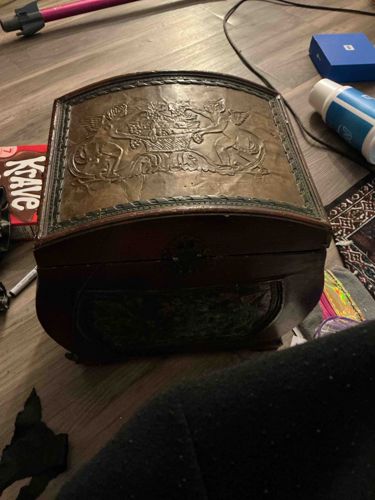
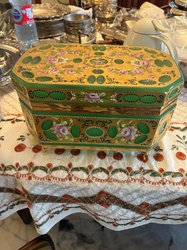
This appears to be an antique or vintage decorative box, likely constructed from wood with an elaborate embossed leather top. The box exhibits a curved or domed lid, predominantly brown in color, with the central focus being a large rectangular panel of intricately embossed leather. This leather panel depicts a classical scene, possibly mythological or allegorical, featuring figures in what appears to be a chariot or carriage pulled by an animal, surrounded by foliage and other decorative elements. The embossing is detailed, suggesting skilled craftsmanship, and shows a noticeable patina, hinting at age. The leather is bordered by a darker, possibly braided or patterned trim. The body of the box itself is a dark, warm-toned wood, showing some wear and possibly minor scratching consistent with age and use. There are no visible maker's marks or signatures in the provided image. The overall style suggests a late 19th or early 20th-century aesthetic, possibly influenced by Renaissance revival or Art Nouveau design, though more precise dating would require closer inspection. The condition seems fair, with the charming imperfections of an aged piece. The craftsmanship, particularly of the embossed leather, indicates a piece intended for decorative use and storage, possibly for trinkets or documents.
AI Appraisal Report
Based on my visual examination of the provided image, this embossed leather and wood box presents as a charming antique or vintage decorative item. The overall condition appears fair, exhibiting a desirable patina on the embossed leather, consistent with age and use. The wear on the dark wood body, including minor scratches, aligns with expectations for an item of its presumed vintage. The embossed leather panel, depicting a classical or mythological scene, is detailed and suggests skilled craftsmanship. However, without a physical inspection, I cannot confirm the leather's exact age, type, or the method of embossing.
Authenticity, in terms of age, is suggested by the style and wear; however, definitive authentication of specific origin or artisan requires in-person examination for construction details, material analysis, and close inspection for subtle maker's marks or signatures that are not visible in the image. Provenance documentation would significantly aid in verifying its history. Without physical access, I cannot ascertain if the leather is original to the box or a later addition, nor can I rule out any restorations.
Market conditions for decorative boxes of this nature are generally steady for well-preserved examples with appealing aesthetics. While not exceptionally rare, the detailed embossed leather adds to its desirability. Comparables tend to fall within a broad range depending on craftsmanship, artistic merit, and verifiable age. Demand exists among collectors of antique decorative arts and those seeking unique interior decor. Factors impacting value include the intricacy and condition of the embossing, the overall integrity of the wood, and the presence or absence of any significant damage or repairs. The appeal of the classical scene in the embossing is a strong subjective value contributor. The limitations of image-based appraisal mean that my assessment of condition is purely visual; in-person inspection would allow for tactile evaluation of material integrity, structural soundness, and detailed examination for repairs or alterations.