AI estimate as of July 30, 2025 · verify with a professional before acting
AI-Generated · Verify before acting
Everything on this page is generated by AI for informational purposes only. AI can make mistakes — the AI may misidentify items or misattribute them (artist, maker, brand, designer, origin, era). This is not an official valuation and should not be used for insurance, sale, tax, estate, legal, or lending purposes — or any decision requiring a certified appraisal. It is not an authoritative claim about any person, brand, or rights holder — do not share or rely on it as a factual statement about a third party. Always consult qualified professionals before making financial decisions.
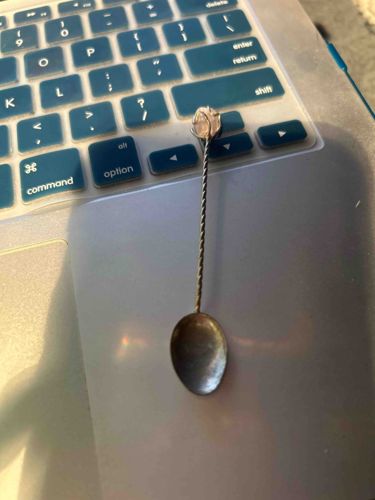
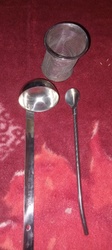
This is a small, decorative spoon, likely a collector's item or a souvenir spoon, not intended for practical culinary use. Its overall length appears to be approximately 3-4 inches, judging by its placement on a laptop keyboard. The spoon features a twisted wire handle, giving it a delicate and antique aesthetic. The material of the handle and bowl appears to be a dark, tarnished metal, possibly silver or silver-plated, showing a significant amount of natural patina consistent with age. At the very top of the handle, there is a prominent decorative element: a multi-faceted, light-colored stone or crystal, possibly rose quartz, securely wire-wrapped to the end of the twisted handle. This stone is irregular in shape but polished, adding a touch of elegance and uniqueness. The spoon's bowl is relatively small and oval-shaped, exhibiting some surface wear and minor scratching consistent with handling and age, contributing to its character. There are no readily visible maker's marks, signatures, or stamps in the provided images, which might suggest a handmade piece or an item from a period where such markings were less common or located elsewhere. The style suggests it could be late 19th to early 20th century, or a modern reproduction in a historical style. The craftsmanship, particularly of the twisted wire handle and the wire-wrapped stone, appears to be of good quality, indicating attention to detail in its manufacture. The visible condition issues seem to be primarily surface tarnish and minor abrasions, which are typical for an older metal object and contribute to its collectible appeal rather than detracting significantly from it.
AI Appraisal Report
Upon visual examination of the 'Twisted Handle Decorative Spoon with Stone Finial' image, I assess its condition as good, commensurate with age. The dark, tarnished appearance suggests silver or silver-plate, exhibiting a natural patina without excessive damage. The twisted handle and wire-wrapped stone finial (possibly rose quartz) show good craftsmanship. Authenticity, based solely on imagery, is challenging; it could be late 19th/early 20th century or a modern reproduction. The absence of clear maker's marks is a limitation. Current market conditions for decorative, non-utilitarian spoons are modest. Demand is niche, primarily from collectors of Victorian/Edwardian era items or those seeking unique decorative accents. Rarity is low as similar items, whether antique or modern artisan pieces, are commonly found. The primary factors impacting value are the unknown metal composition (solid silver would significantly increase value) and its true age/origin. Without in-person examination to assess metal quality, weight, and subtle construction cues, and without provenance documentation or scientific testing (e.g., XRF analysis for metal composition), definitive authenticity and a precise historical period cannot be established. For full authentication, I would require a direct physical inspection to evaluate hallmarks, material integrity, and detailed craftsmanship, confirming if it's an authentic antique versus a more recent decorative piece.