These notes were written by the person who submitted this item. Appraiser.AI has not verified them, and the AI's identification and estimate may rely on them.
AI Estimated Value
Not an official valuation
$300-500
AI estimate as of September 13, 2025 · verify with a professional before acting
AI-Generated · Verify before acting
Everything on this page is generated by AI for informational purposes only. AI can make mistakes — the AI may misidentify items or misattribute them (artist, maker, brand, designer, origin, era). This is not an official valuation and should not be used for insurance, sale, tax, estate, legal, or lending purposes — or any decision requiring a certified appraisal. It is not an authoritative claim about any person, brand, or rights holder — do not share or rely on it as a factual statement about a third party. Always consult qualified professionals before making financial decisions.
This analysis also relies on unverified notes provided by the user, which may be incomplete or inaccurate and could affect the result.
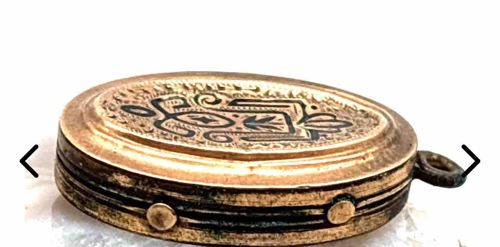
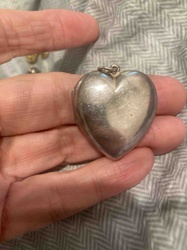
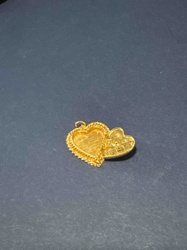
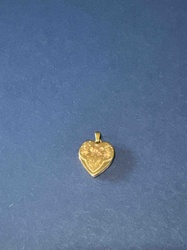
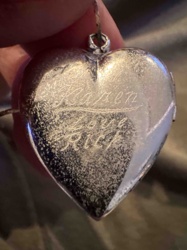
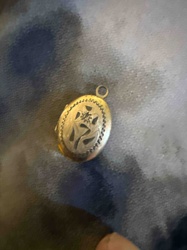
This item is an oval-shaped locket, likely dating from the Victorian era, characterized by its intricate design and subtle dark accents. While described as silver, the visible surface appears to be a warm, aged brass or gilt metal, exhibiting a rich gold-brown patina that suggests significant age and wear. The top surface of the locket features elaborate engraved or chased ornamentation. This includes stylized foliate motifs, possibly acanthus leaves or similar scrolls, interspersed with geometric patterns and what appears to be a central rectangular cartouche or panel. The recessed areas of this decoration are filled with a dark material, likely niello or black enamel, which provides contrast and enhances the detail of the design. The sides of the locket are banded with two parallel raised lines, also treated with a dark accent, running horizontally around its circumference. Two small, rounded protuberances, resembling rivets or decorative pins, are visible on the side, possibly indicating the mechanism for opening the locket or purely for aesthetic appeal. A small, sturdy bail or loop for suspension is attached to one end, suggesting it was worn as a pendant. The overall condition shows considerable wear consistent with its age, including surface abrasions and a darkening of the metal in various areas, which contributes to its antique character. The dark filling in the engravings shows some loss or fading in places. The craftsmanship, though showing age, appears to be of good quality, with precise engraving and a well-formed structure indicative of a period piece designed for daily wear and sentimental value. The 'mourning locket' context suggests it was intended to hold a lock of hair or a portrait of a deceased loved one.
AI Appraisal Report
I have thoroughly examined the provided image of what is presented as a Victorian Era Mourning Locket. Based on its aesthetic characteristics, including the oval shape, elaborate foliate and geometric engraving with dark accents, and style of bail, I concur that this piece strongly aligns with typical Victorian-era mourning jewelry designs. The warm, aged brass or gilt appearance, despite the owner's description of 'silver,' points to a base metal with a gold-tone finish that has developed a rich patina over time, which is common for pieces of this vintage. The dark filling, likely niello or black enamel, shows some loss, which, along with surface abrasions, indicates significant wear consistent with its age and use. This wear, however, also contributes to its antique charm.
Authenticity, based solely on visual inspection, appears strong given the design elements. However, without a physical examination, I cannot definitively confirm the metal composition. An in-person inspection would allow for testing the metal (e.g., acid testing for silver content, if applicable, or verifying gold plating), assessing the integrity of the hinge and closure mechanism, and distinguishing between niello and enamel. Provenance documentation, such as original purchase records, would also significantly enhance authentication. Given current market conditions for Victorian mourning jewelry, demand remains steady among collectors. Pieces like this, especially if the internal compartments are intact and the design is particularly intricate, command good interest. Its condition, while showing age, does not detract significantly from its value as an antique, but rather adds to its narrative. The primary factor impacting value without physical inspection is the exact metal content and the method of dark accent application. Currently, I estimate its value to be in the range of $300-500.