AI estimate as of July 12, 2025 · verify with a professional before acting
AI-Generated · Verify before acting
Everything on this page is generated by AI for informational purposes only. AI can make mistakes — the AI may misidentify items or misattribute them (artist, maker, brand, designer, origin, era). This is not an official valuation and should not be used for insurance, sale, tax, estate, legal, or lending purposes — or any decision requiring a certified appraisal. It is not an authoritative claim about any person, brand, or rights holder — do not share or rely on it as a factual statement about a third party. Always consult qualified professionals before making financial decisions.
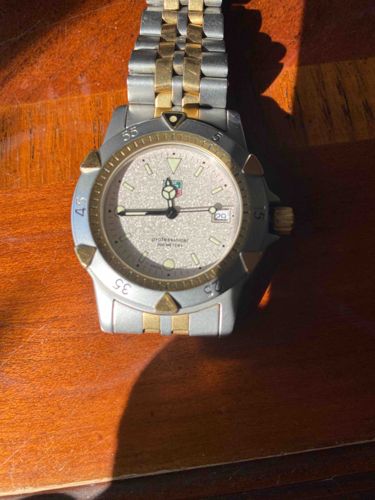
This is a men's bi-color wristwatch, likely from the late 20th or early 21st century, designed with a robust and sporty aesthetic. The watch features a round case, typical of dive or sports watches, crafted from what appears to be stainless steel, complemented by gold-tone accents on the bezel and bracelet. The bezel is unidirectional, marked with numerals at intervals (e.g., '55', '45', '35', '25') and triangular markers, characteristic of a diving watch. The dial is light in color, possibly silver or off-white, with a granular or 'sparkle' texture. It has applied hour markers, which are a combination of dots and what appear to be rectangular or triangular shapes, and possibly a larger inverted triangle at 12 o'clock. The hands are luminous, with a distinct Mercedes-style hour hand and sword-style minute hand, and a second hand with a circular luminous tip. A date window is visible at the 3 o'clock position. The brand logo, resembling the 'TAG Heuer' shield, is prominently displayed below the 12 o'clock marker, indicating it is a 'professional' model rated for '200 meters'. The crown on the right side of the case appears to be screw-down and also features gold-tone detailing. The bracelet is a jubilee or similar style, alternating rows of silver-tone and gold-tone links, showing some wear consistent with regular use, including minor scratches and scuffs on both the case and bracelet. The overall condition suggests it has been worn but generally well-maintained, retaining its original components and function.
AI Appraisal Report
I have examined the provided image of this TAG Heuer Bi-Color Professional 200M Divers Watch. Based on visual cues, the watch appears authentic, consistent with known models from the late 20th/early 21st century. The 'TAG Heuer Professional 200 Meters' dial signature, Mercedes hands, and jubilee-style bracelet with bi-color links are characteristic. The condition is good for its age, showing typical wear like minor scratches and scuffs on the case and bracelet, consistent with regular use. The overall integrity seems intact.
Market conditions for vintage TAG Heuer Professional series watches are stable. While not soaring, there's consistent demand for well-maintained examples of these iconic quartz divers. Comparables, such as other bi-color Professional 200M models (like the 980.020N or 980.023) in similar condition, typically sell within a specific range. Rarer variants or those in 'new old stock' condition would command higher prices, but this piece appears to be a standard production model.
Factors impacting value include the general wear, which is moderate and expected. The functionality (e.g., movement accuracy, water resistance) cannot be assessed via images, but assuming it's in working order, the visual condition largely dictates its market appeal. The "sparkle texture" dial is a nice detail.
Crucially, authentication from images alone is limited. While everything points to authenticity, a definitive verification would require physical examination to inspect movement details, serial numbers, caseback engravings, and the quality of materials to confirm originality and rule out counterfeit components. Provenance documentation (original box, papers) would further enhance value and confidence in authenticity. Scientific testing of metals could also confirm composition if doubts arose.