AI estimate as of September 26, 2025 · verify with a professional before acting
AI-Generated · Verify before acting
Everything on this page is generated by AI for informational purposes only. AI can make mistakes — the AI may misidentify items or misattribute them (artist, maker, brand, designer, origin, era). This is not an official valuation and should not be used for insurance, sale, tax, estate, legal, or lending purposes — or any decision requiring a certified appraisal. It is not an authoritative claim about any person, brand, or rights holder — do not share or rely on it as a factual statement about a third party. Always consult qualified professionals before making financial decisions.
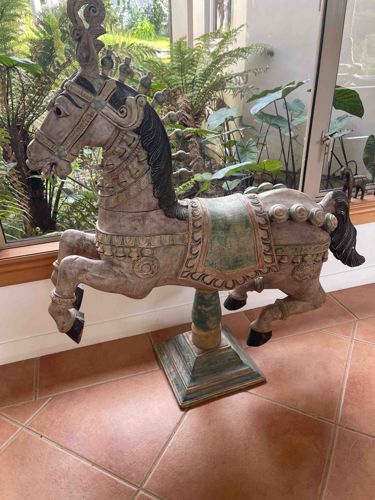
This is a large, hand-carved wooden horse figure mounted on a square base, appearing to be an Indian-style decorative piece. The horse is depicted in a dynamic, mid-stride pose, suggesting movement. Its primary coloration is a distressed light grey-green, with accents of darker green, black, and possibly some faded red or orange details (particularly on the saddle blanket and some decorative elements). The carving exhibits significant detail, especially in the horse's head, mane, and harness, which features elaborate scrollwork and a prominent, ornate finial atop its head. The mane and tail are carved in black, providing a striking contrast to the lighter body. A saddle blanket is visible, adorned with patterned carving and painted in green with lighter details. The horse's legs are robust, terminating in darker hooves. The entire structure is supported by a single, thick central post that connects to a tiered, square base. Both the post and base are painted to match the distressed green-grey aesthetic of the horse, showing areas of paint loss and wear. The overall condition suggests an aged or antique piece, with clear signs of wear, including chipped paint, abrasions, and a natural patina consistent with wood and painted surfaces over time. The craftsmanship indicates a hand-carved origin, with visible tool marks and irregularities that add to its rustic charm. The scale of the piece suggests it functions as a substantial decorative object or possibly a display prop. It appears to be made from a solid, medium-density wood.
AI Appraisal Report
I have carefully examined the provided image of this Carved Wooden Indian Horse on Stand. This substantial decorative sculpture, likely Indian in origin, exhibits clear hand-carved artistry. Its dynamic mid-stride pose and elaborate detailing on the harness, mane, and saddle blanket are notable, showcasing skilled craftsmanship. The distressed light grey-green coloration, accented with darker hues and faded red/orange, contributes to its antique aesthetic.
My assessment of its condition, based solely on the image, suggests an aged piece with expected wear. I observe chipped paint, abrasions, and a natural patina consistent with wood and painted surfaces over time, which enhance its rustic charm rather than detract from its perceived age. The visible tool marks further confirm its hand-carved origin.
Market comparables for substantial, hand-carved decorative wooden horses, particularly those with an Indian or Asian aesthetic and discernible age, typically fall within a broad range. Pieces of this scale and detail, representing cultural decorative art, are generally sought after by interior designers and collectors of unique global décor. Demand is steady for well-executed folk art and cultural sculptures. While not exceedingly rare, pieces of this size and quality are not commonplace.
Factors significantly impacting its value include its size, intricate carving, apparent age, and overall decorative presence. The distressed finish, while intentional, also aligns with current aesthetic trends.
Limitations in authenticity verification from an image alone are considerable. While it appears to be a genuine vintage or antique piece, definitive age dating and confirmation of its precise origin (e.g., specific region in India) would require in-person examination. Physical inspection would allow me to assess the wood type, construction methods, and examine paint layers more closely for true indicators of age and originality. Provenance documentation, if available, would also be crucial, and scientific testing of the materials could provide conclusive evidence regarding its age and composition.