AI Appraisal Estimate

AI-generated estimates · not official valuations

From the user

What was submitted

Photo and notes provided by the user — not generated by AI

Submitted item photo
Submitted photo · June 26, 2026

User's notes

No additional notes provided.

AI analysis below

AI appraisal

AI analysis & estimate

AI-Generated · Verify before acting

Everything below is generated by AI for informational purposes only. AI can make mistakes — the AI may misidentify items or misattribute them (artist, maker, brand, designer, origin, era). This is not an official valuation and should not be used for insurance, sale, tax, estate, legal, or lending purposes — or any decision requiring a certified appraisal. It is not an authoritative claim about any person, brand, or rights holder — do not share or rely on it as a factual statement about a third party. Always consult qualified professionals before making financial decisions.

Read the full disclaimer

AI Identification

·Not independently authenticated·Verify before acting

Vintage Anthropomorphic Figural Metal Hand Bell

Vintage Collectibles / Novelty Bells

AI Estimated Value

·Not an official valuation·Verify before acting

$15 - $25

As of June 26, 2026

AI Item Analysis

·AI can make mistakes·Verify before acting
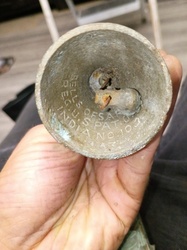
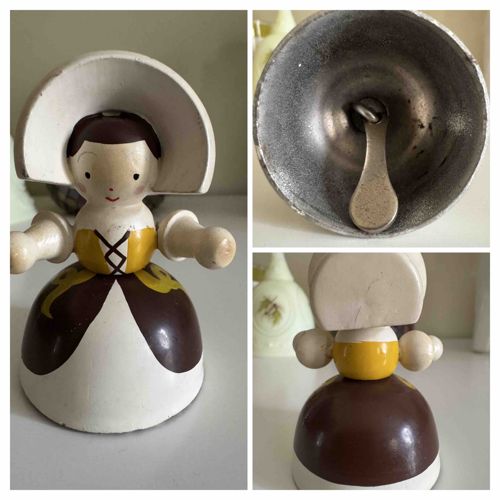
This item is a vintage hand bell featuring an anthropomorphic female figure, likely representing a Dutch or Swiss girl. The piece is constructed primarily of cast metal with a decorative painted finish. The figure stands approximately 3.5 to 4 inches tall. Her design includes a large white bonnet, a yellow bodice with black laced detailing, and a wide brown and white skirt that functions as the bell's resonator. The arms are rendered as simple white rounded protrusions. Notable features include a hand-painted face with simple dot eyes and a small red smile. The interior of the bell shows a heavy metal clapper attached via a wire loop, revealing the unpainted, oxidized metallic surface of the casting. The condition is consistent with mid-20th-century age, showing visible paint loss and scuffing along the sharp edges of the bonnet and the base of the skirt. There is significant patina and minor spotting inside the bell. This style of souvenir or novelty bell was common from the 1940s through the 1960s. The craftsmanship is folk-art inspired, with simple but charming geometric shapes and a semi-gloss finish. No specific maker's mark is visible in the provided views, though items of this type often originated from European souvenir manufacturers or American giftware companies like Enesco or Lefton.


AI Appraisal Report

·AI can make mistakes·Verify before acting
Based on my visual examination of this vintage anthropomorphic figural hand bell, I have assessed it as a mid-20th-century novelty souvenir, likely dating from the 1950s. The piece exhibits a folk-art aesthetic characteristic of mass-produced giftware from the post-war era. The construction is a zinc-alloy or 'pot metal' casting. The condition is fair to good; while the structural integrity is sound, there is significant topical paint loss on the 'bonnet' and 'skirt' edges, which common for pieces of this age and material. The interior oxidation is consistent with atmospheric exposure over several decades. The market for generic figural bells is currently saturated, with high supply and moderate demand. Collectors generally prioritize pieces with verified 'Lefton' or 'Enesco' foil labels or rare character designs. Since this example lacks a maker’s mark and shows notable wear, its value is primarily decorative rather than as a high-investment collectible. Comparables for non-branded metal souvenir bells in similar condition typically realize prices in the $15–$25 range at auction or in antique malls. It is important to note that this appraisal is based on photographic evidence alone. My assessment of the metal composition is speculative and cannot account for the weight or 'ring' tone of the bell, which are vital for discerning higher-quality bronzes from common alloys. For a definitive authentication, an in-person inspection would be required to look for hidden stamps under the patina and to confirm the lead content of the paint via XRF testing if safety or age-verification were a concern. No provenance was provided, which limits the ability to link the item to a specific historical manufacturer.

Get your items appraised

Instant estimates of your treasures with AI-powered appraisals

Browse More Appraisals