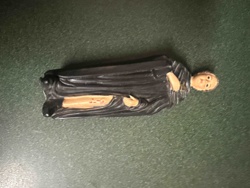
Purchased in Vietnam in the early 1960’s, it’s 2 inches tall & 1 inch wide
These notes were written by the person who submitted this item. Appraiser.AI has not verified them, and the AI's identification and estimate may rely on them.
AI Estimated Value
Not an official valuation
$350-550
AI estimate as of November 6, 2025 · verify with a professional before acting
AI-Generated · Verify before acting
Everything on this page is generated by AI for informational purposes only. AI can make mistakes — the AI may misidentify items or misattribute them (artist, maker, brand, designer, origin, era). This is not an official valuation and should not be used for insurance, sale, tax, estate, legal, or lending purposes — or any decision requiring a certified appraisal. It is not an authoritative claim about any person, brand, or rights holder — do not share or rely on it as a factual statement about a third party. Always consult qualified professionals before making financial decisions.
This analysis also relies on unverified notes provided by the user, which may be incomplete or inaccurate and could affect the result.
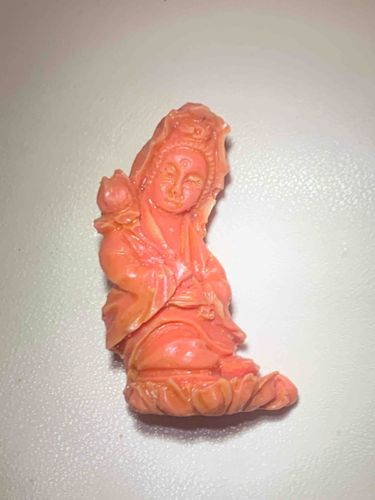
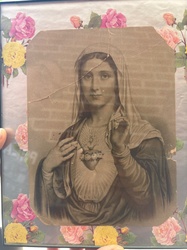
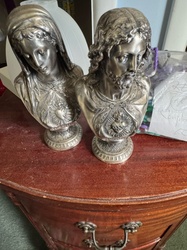
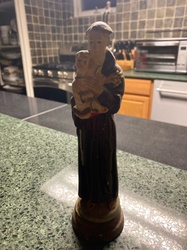
This is a small, hand-carved figurine or potential pendant depicting Guanyin, the Bodhisattva of Compassion, often revered in East Asian Buddhism. The item measures approximately 2 inches tall and 1 inch wide, consistent with the provided context. It is carved from a vibrant, opaque coral material, exhibiting a reddish-orange hue with lighter tones appearing in the recessed areas and on raised edges due to natural variation or surface wear. The carving shows Guanyin in a seated or reclining posture, possibly holding a lotus bud or flower in her left arm, which is a common attribute. Her face is serene, with fine details visible for the eyes, nose, and mouth, and she wears an elaborate headdress. The drapery of her robes is rendered with flowing lines, suggesting movement and soft folds. The base upon which she sits appears to be a lotus pedestal, intricately carved with individual petals. The overall craftsmanship suggests a skilled hand, with attention to detail in the delicate features and flowing forms. The texture of the coral appears somewhat porous or naturally irregular in places, which is typical for the material. Minor surface wear is visible, consistent with an item purchased in the early 1960s and potentially handled or worn. There are no obvious chips, cracks, or repairs visible in the provided images, indicating good preservation. Given its purchase in Vietnam in the early 1960s, it aligns with a mid-20th century East Asian folk art or devotional art style.
AI Appraisal Report
Having carefully examined the provided images and information regarding this carved coral Guanyin figurine, I can offer the following professional appraisal. The piece, measuring approximately 2 inches tall and 1 inch wide, is carved from vibrant, opaque coral, showing natural reddish-orange tones with lighter areas, consistent with the material. The craftsmanship is commendable, depicting Guanyin in a serene, reposed posture on a lotus pedestal, holding what appears to be a lotus bud. Details like her facial features, intricate headdress, and the flowing drapery of her robes are well-executed, indicating a skilled hand. The overall condition appears good, with minor surface wear consistent with its acquisition in the early 1960s and subsequent handling, but no obvious chips, cracks, or repairs are visible from the images. This piece belongs to the category of East Asian devotional art or folk art from the mid-20th century. While visual authentication of the material as genuine coral is strong based on its texture and color variations, a conclusive determination would ideally require in-person inspection. Similarly, confirming its Vietnamese origin or specific artistic school solely from images is challenging. Market demand for such smaller, carved coral devotional pieces is steady, particularly for items with good craftsmanship and condition. Comparables often include similar coral carvings from East Asia, varying in detail and size. The primary drivers of value here are the intrinsic beauty of the coral, the quality of the carving, and its good state of preservation. The lack of extensive provenance beyond its purchase location and date, as well as the inherent limitations of appraising from images, prevent me from assigning a higher value. For full authentication and to ascertain the exact type of coral (e.g., precious coral), a physical examination by a gemologist and an art historian specializing in East Asian carvings would be recommended. In addition, detailed provenance documentation would significantly enhance its value.