AI estimate as of September 18, 2025 · verify with a professional before acting
AI-Generated · Verify before acting
Everything on this page is generated by AI for informational purposes only. AI can make mistakes — the AI may misidentify items or misattribute them (artist, maker, brand, designer, origin, era). This is not an official valuation and should not be used for insurance, sale, tax, estate, legal, or lending purposes — or any decision requiring a certified appraisal. It is not an authoritative claim about any person, brand, or rights holder — do not share or rely on it as a factual statement about a third party. Always consult qualified professionals before making financial decisions.
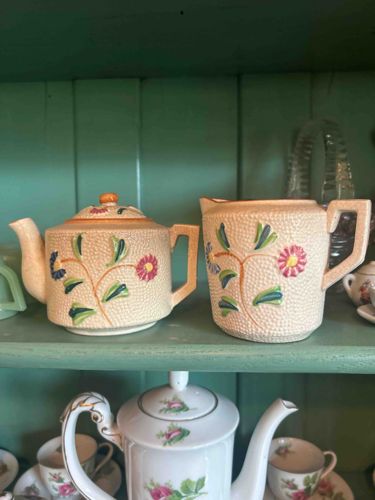
This set consists of a teapot with its lid and a creamer, both rendered in a distinct majolica-style ceramic, characterized by a textured, stippled or 'pebble' ground applied to an off-white or cream-colored base. The pieces are adorned with hand-painted floral motifs featuring stylized flowers and foliage. The flowers appear in shades of pink/red and blue, with green leaves and stems, suggesting a vibrant, naturalistic theme. The teapot has a bulbous body, a short spout, and a square-shaped handle. Its domed lid features a small, round finial, painted in a contrasting orange/brown color. The creamer has a similar textured surface and floral decoration, with a wider mouth and a rectangular handle matching that of the teapot. The general construction indicates a molded ceramic process, likely earthenware, given the style. No discernible maker's marks or signatures are visible in the provided image. The style, particularly the textured surface and hand-painted floral designs, points towards a mid-20th century production, possibly 1930s-1950s, popular in cottagecore or chintz aesthetics. The condition appears good from the photo, with no obvious chips or cracks, although closer inspection would be needed to assess any minor wear, crazing, or paint loss. The quality of craftsmanship is fair, typical of mass-produced decorative ceramics of the period, with an emphasis on charm and visual appeal rather than fine porcelain precision.
AI Appraisal Report
Upon visual examination of the provided image, I assess this Vintage Majolica-Style Teapot and Creamer Set. The condition appears good, with no obvious chips or cracks visible. However, without a physical inspection, I cannot confirm the absence of minor wear, crazing, or paint loss, which is common in ceramics of this age. Authenticity is determined by stylistic attributes; the textured, 'pebble' ground, hand-painted floral motifs, and forms are consistent with mid-20th century majolica-style earthenware, likely from the 1930s-1950s. The absence of maker's marks is typical for mass-produced decorative ceramics of this period, making attribution to a specific manufacturer difficult without provenance.
Market conditions for such decorative ceramic sets are generally stable but not exceptionally strong. While charming, these pieces fall into a category of collectible that appeals to niches interested in 'cottagecore' or vintage chintz aesthetics rather than high-end collectors. Comparable items, often found in online marketplaces or antique shops, typically sell in the $40-70 range for a complete set in good condition. Demand is moderate, driven by decor trends rather than rarity, as many similar sets were produced. Factors impacting value include the good perceived condition, the completeness of the set (teapot with lid and creamer), and its decorative appeal. The lack of distinguishing marks or exceptional craftsmanship, typical for mass-market items, limits its upper value.
For full authentication and a definitive condition assessment, an in-person examination would be crucial to check for hairline cracks, crazing, repairs, and to verify the ceramic body and paint application. Scientific testing would not be necessary for an item of this type unless there were questions regarding the age of materials. Provenance documentation, while not present, would further confirm its origin and history.