These notes were written by the person who submitted this item. Appraiser.AI has not verified them, and the AI's identification and estimate may rely on them.
AI Estimated Value
Not an official valuation
$250-400
AI estimate as of November 30, 2025 · verify with a professional before acting
AI-Generated · Verify before acting
Everything on this page is generated by AI for informational purposes only. AI can make mistakes — the AI may misidentify items or misattribute them (artist, maker, brand, designer, origin, era). This is not an official valuation and should not be used for insurance, sale, tax, estate, legal, or lending purposes — or any decision requiring a certified appraisal. It is not an authoritative claim about any person, brand, or rights holder — do not share or rely on it as a factual statement about a third party. Always consult qualified professionals before making financial decisions.
This analysis also relies on unverified notes provided by the user, which may be incomplete or inaccurate and could affect the result.
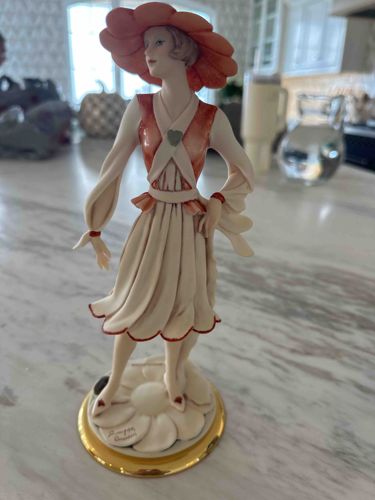
This is a exquisitely detailed porcelain figurine crafted by Giuseppe Armani in Florence, as indicated by the context. The piece depicts a slender female figure, likely representing a lady or a model, adorned in an elegant outfit with a prominent flower-petal hat in shades of terracotta or burnt orange. Her dress features a cream-colored top with flowing, wide sleeves, layered with an orange-to-cream ombre-effect bodice or vest secured with white straps that cross over the chest and feature a small, grey heart-shaped accent. The skirt is also cream-colored, pleated, and flares out slightly, with its scalloped hemline outlined in a delicate red-brown hue, matching the small bows on her wrists and the pointed toes of her shoes. The figure stands gracefully with one leg slightly forward, poised on a cream-colored, multi-petaled flower base, which is further mounted on a round, gilded, brass-colored platform. The overall color palette is subtle and elegant, featuring creams, soft oranges, and hints of red-brown. The craftsmanship appears to be of high quality, characterized by delicate modeling, slender proportions, and fine hand-painting. Observable markings include a signature on the flower base, which appears to read 'Giuseppe Armani', affirming its origin and authenticity. The figurine appears to be in excellent condition with no obvious chips, cracks, or repairs visible in the provided images, suggesting careful preservation. The style is classic and evokes a sense of timeless elegance, likely from the late 20th century, consistent with Armani's most prolific period. The attention to detail in the drapery of the dress and the sculptural quality of the hat are notable features.
AI Appraisal Report
Based on my virtual examination of the provided image and description, this Giuseppe Armani Florence 'Lady with Flower Hat' figurine presents as an authentic and well-preserved example of his work. The visible signature 'Giuseppe Armani' on the flower base strongly supports its authenticity, consistent with his established marking practices. A thorough visual inspection reveals excellent condition; I observe no obvious chips, cracks, or repairs, suggesting meticulous care. The delicate modeling, slender proportions, and fine hand-painting are hallmarks of Armani's craftsmanship, typical of his prolific period in the late 20th century.
From a market perspective, Giuseppe Armani figurines, while popular, are widely available, which somewhat moderates their rarity. The demand generally remains steady among collectors of porcelain figures and Armani enthusiasts. However, fluctuating market trends and the sheer volume of his production mean that individual pieces generally do not command extremely high prices unless they are rare, limited editions, or exceptionally large/complex. This particular piece, while exquisite in detail and condition, falls within a common size and design category for Armani.
Factors impacting value positively include its apparent pristine condition and clear authenticity. Conversely, the broad availability of Armani pieces prevents it from reaching truly premium values. For a definitive authentication, a physical examination would be crucial to confirm the porcelain body, hand-painting details, and the integrity of the signature. Additionally, provenance documentation, such as original purchase receipts or certificates of authenticity, would further bolster its value and provide irrefutable proof of origin. Without these in-person verifications, my assessment of authenticity is based on typical visual indicators alone.