AI estimate as of October 26, 2025 · verify with a professional before acting
AI-Generated · Verify before acting
Everything on this page is generated by AI for informational purposes only. AI can make mistakes — the AI may misidentify items or misattribute them (artist, maker, brand, designer, origin, era). This is not an official valuation and should not be used for insurance, sale, tax, estate, legal, or lending purposes — or any decision requiring a certified appraisal. It is not an authoritative claim about any person, brand, or rights holder — do not share or rely on it as a factual statement about a third party. Always consult qualified professionals before making financial decisions.
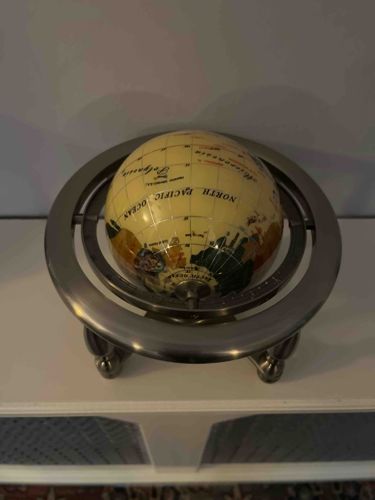
This item is a decorative gemstone globe presented within a silver-toned armillary-style stand. The globe itself appears to be crafted from various polished gemstones, cut and inlaid to represent the continents and oceans. The landmasses are depicted in different earth-toned colors, such as browns, greens, and possibly yellows, suggesting a mosaic or marquetry technique using natural stones. The oceans are represented by a lighter, creamy or off-white stone, with 'PACIFIC OCEAN' and 'NORTH AMERICA' clearly visible in a dark, likely black, script. Lines of longitude and latitude are also visible on the globe's surface. The globe is cradled within a metallic, possibly brass or aluminum, stand with a brushed or satin silver-toned finish. The stand features a circular base with three ornate, possibly claw-footed or bun-shaped, legs that elevate the globe. An armillary sphere design with multiple concentric rings encircles the globe, allowing it to rotate. The overall condition appears good with no obvious major damage, such as cracks, chips, or significant tarnish on the metal. The style is classical yet decorative, suggesting it could be a modern reproduction or a piece from the mid-to-late 20th century, designed for display in an office, study, or living room. The craftsmanship indicates a level of detail in the gemstone inlay and metalwork, making it more than a simple souvenir, but likely a mass-produced decorative item rather than an antique scientific instrument.
AI Appraisal Report
Upon visual examination of the provided image, I assess this gemstone globe with a silver-toned armillary stand to be in good overall condition. There are no obvious cracks, chips to the inlaid gemstones, or significant tarnishing/damage to the metalwork, which would detract from its decorative appeal. Authenticity, in this context, refers to it being a genuine decorative gemstone globe rather than a scientific instrument or a high-value antique; it appears to be exactly as described. The craftsmanship, while detailed in the gemstone inlay and metalwork, points towards a mass-produced decorative item, likely from the mid-to-late 20th century or more recent, rather than a rare antique. This is suggested by the uniformity and common styling found in similar items on the market.
Market conditions for such decorative gemstone globes are relatively stable. Comparables on online marketplaces and specialty decor sites typically range from $100 to $400, depending on size, intricacy of the gemstone work, and the quality of the stand. Items with more complex armillary spheres or larger sizes tend to command higher prices. Demand is moderate, primarily from individuals seeking unique office or home decor. Rarity is low, as these items were produced in significant quantities.
Factors significantly impacting value include the actual types and quality of gemstones used (which cannot be definitively determined from an image), the precision of the inlay, and the material and finish quality of the stand. Without physical inspection, I cannot confirm exact gemstone types, the weight of the metal, or the absence of subtle flaws such as minor lifting of inlays or minute scratches that might be present.
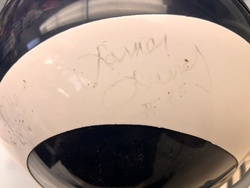
Limitations in authenticity verification are inherent in image-only appraisals. A full authentication would require in-person examination to assess the tactile quality of the stones and metal, confirm gemstone types through gemological testing, and inspect for any maker’s marks or labels that could indicate origin or manufacturer. Provenance documentation would also be valuable to establish its history and original purchase details. Based on the visual evidence, it functions primarily as a decorative object.