AI estimate as of September 17, 2025 · verify with a professional before acting
AI-Generated · Verify before acting
Everything on this page is generated by AI for informational purposes only. AI can make mistakes — the AI may misidentify items or misattribute them (artist, maker, brand, designer, origin, era). This is not an official valuation and should not be used for insurance, sale, tax, estate, legal, or lending purposes — or any decision requiring a certified appraisal. It is not an authoritative claim about any person, brand, or rights holder — do not share or rely on it as a factual statement about a third party. Always consult qualified professionals before making financial decisions.
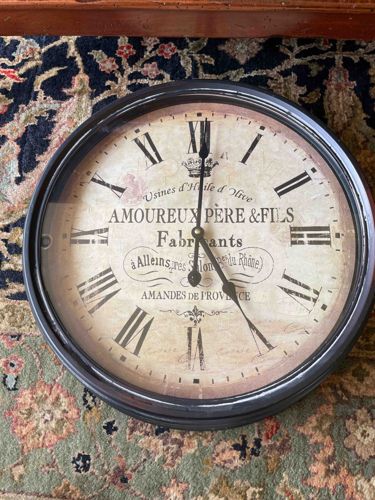
This is a circular wall clock designed in a distressed French Country or shabby chic style, featuring a dark, possibly matte black or oil-rubbed bronze-finished frame, which appears to be made of metal or rigid plastic imitating metal. The frame has a slightly beveled edge, adding depth to the piece. The clock face is adorned with Roman numerals (I through XII), printed in a bold, dark typeface, and features classic sword or spade-style hour and minute hands in a contrasting dark color, likely black or dark brown. The background of the clock face is designed to emulate aged parchment or paper, with a cream or light beige color and subtle, deliberately faded 'stains' or 'discoloration' to enhance its antique appearance. Central to the design are various French texts: 'Usines d'Huile d'Olive', 'AMOUREUX PÈRE & FILS', 'Fabrants', 'à Alleins, près Salon, du Rhône)', and 'AMANDES DE PROVENCE', suggesting a vintage advertisement theme, possibly for an olive oil or almond product from Provence. A stylized crown or crest is visible near the top, above 'AMOUREUX PÈRE & FILS', further reinforcing the antique aesthetic. The numbers are clear and legible despite the distressed background. There are no obvious signs of significant damage like cracks or chips; the visible 'wear' on the face is intentional as part of the design. The protective cover over the face, likely glass or acrylic, shows some reflections but no apparent scratches or haziness. The clock appears to be a decorative item, likely mass-produced to evoke a vintage French market or industrial sign. The craftsmanship seems standard for a decorative home accent, with the primary 'quality' deriving from its aesthetic appeal rather than intricate mechanical work. Its estimated age is contemporary, designed to look antique.
AI Appraisal Report
Upon visual examination of this French Country Style Wall Clock, I assess its condition to be excellent, consistent with a new or nearly new decorative item. The 'distress' and 'aging' are clearly intentional design elements, not actual wear or damage. The face is free from scratches or haziness, and the frame shows no signs of significant impact or degradation. Authenticity-wise, this is a contemporary, mass-produced decorative item designed to evoke a vintage French aesthetic; it is not an antique. Its authenticity lies in its execution of the intended style, which it achieves successfully.
Market conditions for such decorative wall clocks are robust, with a wide array of similar 'shabby chic' or 'French Country' items readily available from home decor retailers, department stores, and online marketplaces. Comparable items, often machine-made with printed faces and metal or plastic frames, typically retail for $30 to $75 new. Demand is steady for items that fit popular interior design trends, which this clock undoubtedly does. However, its mass-produced nature means there is no rarity; these designs are ubiquitous.
The primary factor impacting value here is its decorative appeal within a current interior design trend. It serves as an aesthetic accent rather than a timepiece of historical or artisanal significance. Without physical inspection, I cannot confirm the exact materials of the frame (metal vs. plastic) or the protective cover (glass vs. acrylic), nor the precise diameter or weight, which could slightly influence perceived quality and, thus, value. Furthermore, the clock's movement type (quartz, mechanical) cannot be determined, though quartz is almost certainly the case for such an item, keeping costs down. Provenance documentation or scientific testing is unnecessary for an item of this type, as it's not being presented as an antique or artisanal piece.