AI estimate as of September 27, 2025 · verify with a professional before acting
AI-Generated · Verify before acting
Everything on this page is generated by AI for informational purposes only. AI can make mistakes — the AI may misidentify items or misattribute them (artist, maker, brand, designer, origin, era). This is not an official valuation and should not be used for insurance, sale, tax, estate, legal, or lending purposes — or any decision requiring a certified appraisal. It is not an authoritative claim about any person, brand, or rights holder — do not share or rely on it as a factual statement about a third party. Always consult qualified professionals before making financial decisions.
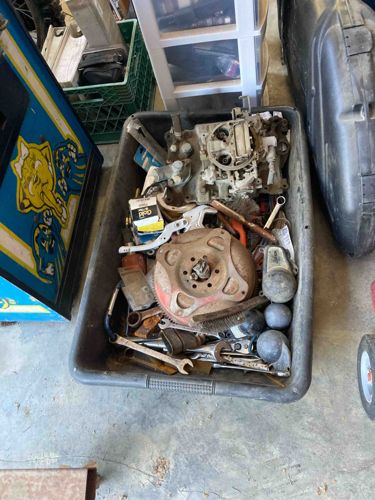
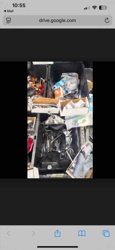
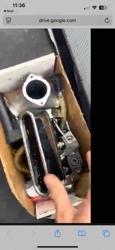
This image depicts a black rectangular plastic storage bin filled with a variety of automotive parts and miscellaneous tools. The items appear to be used, displaying significant wear, grime, and rust, suggesting they have been stored for some time or are intended for repair/restoration projects. Prominently visible is a carburetor, likely made of aluminum or a similar light alloy, showing typical grime accumulation from engine exposure. Next to it, a red-painted flywheel or flex plate, made of cast iron or steel, exhibits surface rust and dirt, with bolted holes and teeth around its perimeter for engagement with a starter motor. Other discernible items include various wrenches (combination wrenches in different sizes), a wire brush with a wooden handle, what appears to be a clutch lever or brake lever assembly, and several spherical components that might be gear shift knobs or part of a suspension system. A small, rectangular, partially visible box with the 'GDP' logo, possibly for an automotive chemical or small part, is also present. The overall condition suggests that the parts are likely salvaged or removed from an older vehicle. There are no clear manufacturer's marks visible on the major components, but their design points towards internal combustion engine applications. The bin itself is a standard heavy-duty utility bin with molded handles, indicating its use for robust storage. The age of the parts is estimated to be older, potentially from the 1960s to 1990s, given the style of the carburetor and the general appearance of the metal components.
AI Appraisal Report
I have examined the provided image of the Assorted Automotive Parts and Tools in Storage Bin. Visually, the components appear to be well-used, displaying significant grime, wear, and surface rust on metal parts. The presence of a carburetor, a red-painted flywheel/flex plate, various wrenches, and other miscellaneous items suggests a collection of parts likely salvaged or removed from an older vehicle. The overall condition indicates these are not new or refurbished items, but rather 'as-is' used parts. The carburetor's style and the general appearance of the metal components suggest an age range potentially from the 1960s to 1990s.
Authenticity from an image alone is limited. I can confirm these are genuine automotive parts and tools based on their identifiable forms (e.g., carburetor, wrenches). However, true authenticity regarding specific vehicle make/model compatibility, or the originality of the carburetor (e.g., matching numbers), would require in-person inspection and comparison with manufacturer's specifications. Provenance documentation could further clarify their origin.
Market conditions for used automotive parts of this nature are generally driven by demand from hobbyists, restorers, or individuals seeking replacement parts for older vehicles. The lack of specific manufacturer markings visible in the image makes pinpointing demand challenging. Generic older carburetors and flywheels, especially in this condition, typically hold modest value unless they are for a highly sought-after classic car. The tools, while functional, appear to be common types. The value would largely depend on someone needing these exact components. Without knowing the exact make and model compatibility, or the operational status of key components like the carburetor or flywheel (which would require physical testing), the value remains speculative.
Factors impacting value significantly are the unknown operational status of the mechanical parts and the lack of specific vehicle application. If these parts were confirmed to be for a rare or desirable classic vehicle, their value could increase substantially, even in this condition. Conversely, if they are for common models, their value remains limited to scrap metal, or a low-cost replacement for individuals on a tight budget. The presence of rust and grime necessitates cleaning and potentially rebuilding before use. Therefore, considering the 'as-is' condition and the impossibility of confirming functionality or specific vehicle application from the image, I estimate a value in the range of $50 to $150. An in-person inspection to identify part numbers, assess internal condition, and test functionality would be crucial for a more precise valuation.