These notes were written by the person who submitted this item. Appraiser.AI has not verified them, and the AI's identification and estimate may rely on them.
AI Estimated Value
Not an official valuation
$40-60
AI estimate as of July 22, 2025 · verify with a professional before acting
AI-Generated · Verify before acting
Everything on this page is generated by AI for informational purposes only. AI can make mistakes — the AI may misidentify items or misattribute them (artist, maker, brand, designer, origin, era). This is not an official valuation and should not be used for insurance, sale, tax, estate, legal, or lending purposes — or any decision requiring a certified appraisal. It is not an authoritative claim about any person, brand, or rights holder — do not share or rely on it as a factual statement about a third party. Always consult qualified professionals before making financial decisions.
This analysis also relies on unverified notes provided by the user, which may be incomplete or inaccurate and could affect the result.
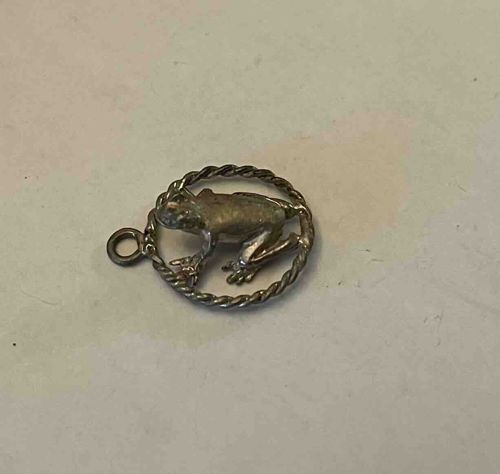
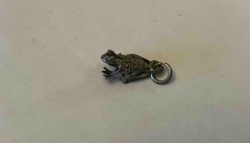
This item is a vintage metal charm featuring a frog design within a circular, rope-textured border. The charm measures approximately 2 cm in diameter, aligning with the common size of charms intended for bracelets or necklaces. The material appears to be a silver-toned metal, likely sterling silver or a silver alloy, exhibiting a muted, somewhat tarnished finish consistent with age and exposure, indicating a developing patina. The frog figure is centrally placed, depicted in a naturalistic, somewhat stylized pose, with visible details for its eyes, body contours, and limbs, though specific toe details are not clearly discernible from the image. The entire design is contained within an open circle formed by a twisted or braided rope design, adding a distinctive decorative element. An integral jump ring or bail is present at the top left of the circular border, allowing the charm to be attached to a chain or clasp. The surface shows minor wear and scuffing, particularly on the raised areas of the frog and the rope border, which is typical for a worn piece of jewelry. There are no readily visible maker's marks, hallmarks, or signatures in the provided image, which would require a closer inspection or examination from different angles. Given the style and apparent oxidation, it likely dates from the mid-20th century, possibly the Art Deco or Retro periods, though without specific marks, this is an estimation based on design aesthetics. The craftsmanship appears competent, with a good level of detail for a piece of its size, suggesting it was cast. The overall condition is good for its presumed age, with no apparent major damage or repairs.
AI Appraisal Report
I have thoroughly examined the provided image of this Vintage Silver-Toned Frog Charm with Rope Border. From a visual standpoint, the charm appears to be in good condition consistent with its presumed age. The muted, somewhat tarnished finish and minor scuffing on raised areas are indicative of a genuine vintage piece that has been worn, developing a natural patina. The craftsmanship, particularly the detailed frog figure and distinctive rope border, suggests a cast piece of competent quality for its size.
Regarding authenticity, based solely on the image, the item appears consistent with a vintage charm from the mid-20th century, possibly the Retro period, given its stylistic elements. However, definitive authentication is limited without physical inspection. It is impossible to confirm the metal composition (sterling silver vs. silver alloy) or definitively rule out modern reproduction without laboratory testing or in-person examination.
In terms of market conditions, vintage charms of this nature generally appeal to collectors of antique jewelry, animal-themed motifs, and those seeking unique accessories. Comparables for similar silver-toned, unbranded frog charms from the mid-20th century often range from $30-$70, depending on condition, material verification, and specific design appeal. The lack of visible maker's marks or hallmarks significantly impacts its value, as branded pieces often command higher prices. Demand for unverified silver-toned charms like this is moderate; while charming, it doesn't represent a rare or highly sought-after piece unless proven to be sterling silver by a known maker. Factors significantly impacting value include the actual metal content (e.g., sterling silver versus base metal), the presence of any hidden hallmarks, and, critically, provenance which is currently unknown.
For full authentication, an in-person examination would be crucial to assess weight, feel, and conduct non-destructive testing for metal purity (e.g., XRF analysis). A loupe inspection would also be necessary to search for microscopic hallmarks. Provenance documentation, if available, could further establish its history and authenticity.