AI estimate as of November 5, 2025 · verify with a professional before acting
AI-Generated · Verify before acting
Everything on this page is generated by AI for informational purposes only. AI can make mistakes — the AI may misidentify items or misattribute them (artist, maker, brand, designer, origin, era). This is not an official valuation and should not be used for insurance, sale, tax, estate, legal, or lending purposes — or any decision requiring a certified appraisal. It is not an authoritative claim about any person, brand, or rights holder — do not share or rely on it as a factual statement about a third party. Always consult qualified professionals before making financial decisions.
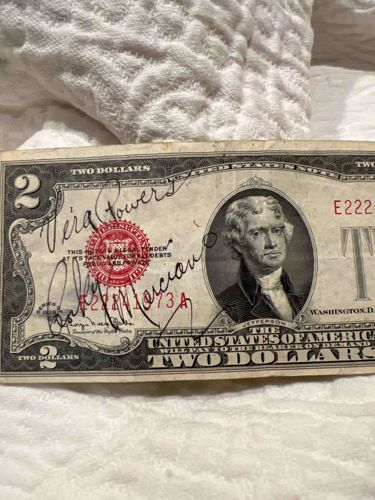
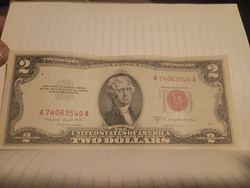
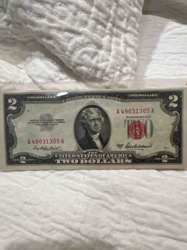
This item is a 1953B Series United States Two Dollar Bill, often referred to as a 'Red Seal' note due to the distinctive red treasury seal and serial numbers. The bill features a portrait of Thomas Jefferson on the obverse. Its primary color scheme is green and black ink printing on an off-white paper, typical of U.S. currency. What makes this particular note stand out is the presence of multiple handwritten signatures on the obverse. There are prominent signatures in black ink, including 'Vera Powers' and 'Marciano' (possibly Rocky Marciano, though this would need expert verification based on a known signature example). There are also additional smaller, illegible signatures around the red treasury seal. The serial number 'E222...' is partially visible in the upper right quadrant, alongside a red 'E' in the lower right, and a handwritten '73A' next to 'Marciano's' signature, which could indicate a date or an identifier. Below the serial number, the phrase 'WASHINGTON.D.' and 'UNITED STATES OF AMERICA' are clearly visible. The overall condition shows signs of use and wear consistent with circulation, including creases, minor edge wear, and some discoloration to the paper. The signatures appear to be applied directly to the circulated note, indicating they were added after its issuance and circulation. The craftsmanship is standard for U.S. federal currency of its era, featuring intricate engravings for security and aesthetic purposes. The visible wear is consistent with a bill from the mid-20th century that has been handled.
AI Appraisal Report
I have examined the image of this 1953B Red Seal Two Dollar Bill with multiple purported autographs. From a visual perspective, the bill itself is a common series, and its circulated condition with creases, edge wear, and discoloration would typically place its value, absent signatures, in the lower range for collectible currency, likely around $5-$10. The craftsmanship of the bill is standard for U.S. currency of its era. The red seal and serial numbers are clear. The visibility of 'E222...' as part of the serial number and 'WASHINGTON.D.' and 'UNITED STATES OF AMERICA' confirms its identity as a standard issue.
The primary value driver for this specific item is the presence of the signatures. The most notable is 'Marciano,' potentially referring to Rocky Marciano. The '73A' next to this signature could be an identifier or a date reference, though its exact meaning is unclear without further context. Another prominent signature, 'Vera Powers,' is also present, along with several other smaller, illegible signatures around the red treasury seal. The signatures appear to be applied in black ink directly onto the circulated note, indicating they were added post-issuance.
Without a direct comparison to authenticated exemplars of Rocky Marciano's signature, I cannot definitively authenticate its legitimacy from an image alone. This is a significant limitation, as the autograph's authenticity has the most substantial impact on value. If the 'Marciano' signature were verifiably authentic, the value could increase considerably, possibly into the hundreds or even thousands, depending on the signature's quality and the current market demand for such an item. However, due to the high volume of fake or attributed signatures on common items designed to increase value, significant skepticism is warranted without proper authentication. The other signatures ('Vera Powers' and illegible ones) do not significantly add to the value unless they are verifiable autographs of known personalities.
Market conditions for celebrity-signed currency are highly dependent on the celebrity's prominence and the autograph's authenticity and appeal. Rarity, in cases like this, is tied to the genuine nature of the autograph, not to the bill itself. Demand for a legitimately signed Rocky Marciano item would be high among sports memorabilia and autograph collectors.
For full authentication, a physical examination by a certified forensic document examiner (handwriting expert) would be crucial to compare the signatures against known, authenticated examples, especially for 'Marciano.' Provenance documentation, such as a letter from the original owner detailing when and where the signatures were obtained, would also significantly enhance authenticity and value. Without these, the value remains speculative and significantly lower, treating the signatures as unverified. My current appraisal reflects the very strong possibility that the signatures are unauthenticated or, in the worst case, forgeries applied to a common, circulated bill. If independently authenticated, a re-appraisal would be necessary.