AI estimate as of November 5, 2025 · verify with a professional before acting
AI-Generated · Verify before acting
Everything on this page is generated by AI for informational purposes only. AI can make mistakes — the AI may misidentify items or misattribute them (artist, maker, brand, designer, origin, era). This is not an official valuation and should not be used for insurance, sale, tax, estate, legal, or lending purposes — or any decision requiring a certified appraisal. It is not an authoritative claim about any person, brand, or rights holder — do not share or rely on it as a factual statement about a third party. Always consult qualified professionals before making financial decisions.
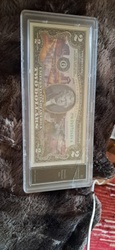
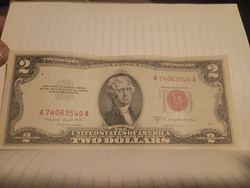
This item is a 1928 Series United States Two-Dollar bill, also known as a 'Legal Tender Note' or 'Red Seal Note' due to the distinctive red Treasury seal and serial numbers. The bill features a portrait of Thomas Jefferson on the obverse, centered within an oval frame. The serial number, A 49031305 A, is printed in red ink on both the left and right sides of the bill. The denomination 'TWO DOLLARS' is prominently displayed at the top center, bottom center, and in numerical form '2' in the top left and right corners. The legend 'UNITED STATES OF AMERICA' is printed below Jefferson's portrait. To the right of Jefferson, the red Treasury seal is clearly visible, featuring a complex design with a key, balance scales, and the word 'TREASURY'. Below the Treasury seal, the signatures of the Register of the Treasury and the Secretary of the Treasury are present, with 'SERIES 1928' indicated below the left signature. The note is contained within a clear plastic sleeve, suggesting it has been preserved by a collector. There are no visible major tears or folds that would typically indicate heavy circulation, and the paper appears relatively crisp, especially for its age, though slight yellowing or toning of the paper is possible but difficult to ascertain precisely from the image. The edges appear clean and uniform, and the printing is sharp, indicating a relatively good state of preservation. The overall craftsmanship is consistent with official United States currency production of the era, known for its intricate engraving and detailed design to prevent counterfeiting. The note's condition is likely uncirculated or lightly circulated, given its containment in a protective sleeve.
AI Appraisal Report
I have examined the provided image of this 1928 Series United States Two-Dollar Legal Tender Note, also known as a 'Red Seal Note.' Based on the visual evidence, the note appears to be authentic, consistent with the design and printing characteristics of official U.S. currency from that era. The distinct red Treasury seal and serial numbers, the portrait of Thomas Jefferson, and the specific 'SERIES 1928' designation all align with known specimens.
The condition of the note appears to be quite good for its age. It is housed in a clear plastic sleeve, which is a positive indicator of collector care. I observe no major tears, significant folds, or substantial creasing. The paper appears relatively crisp, and the printing is sharp, suggesting it is likely in uncirculated (UNC) or lightly circulated (AU/XF) condition. Slight yellowing, or toning, which is common with age, is difficult to definitively assess from the image alone but appears minimal. The edges seem clean and uniform.
Market conditions for 1928 Red Seal Two-Dollar notes are generally stable. While not extremely rare, notes in high grades (UNC or AU) command significant premiums over circulated examples. Comparables in similar apparent condition typically range from $60 to $120. Factors impacting this value include the note's apparent high-grade preservation, which increases desirability among collectors. The specific serial number, A 49031305 A, does not immediately suggest any 'fancy serial' premium, such as low numbers or solid digits.
My primary limitation in this appraisal is the lack of a physical examination. While the image strongly supports authenticity and good condition, an in-person inspection would be crucial for definitive authentication and a precise grade. I would specifically look for subtle signs of restoration, paper thinning, pinholes, or minor unnoticed folds that can significantly affect grading. Verifying the texture and crispness of the paper, as well as examining the print quality under magnification for any signs of counterfeiting, would also be essential for full authentication beyond what an image can provide. Provenance documentation, if available, would also add value and confirm its history.