These notes were written by the person who submitted this item. Appraiser.AI has not verified them, and the AI's identification and estimate may rely on them.
AI Estimated Value
Not an official valuation
$250-400
AI estimate as of September 7, 2025 · verify with a professional before acting
AI-Generated · Verify before acting
Everything on this page is generated by AI for informational purposes only. AI can make mistakes — the AI may misidentify items or misattribute them (artist, maker, brand, designer, origin, era). This is not an official valuation and should not be used for insurance, sale, tax, estate, legal, or lending purposes — or any decision requiring a certified appraisal. It is not an authoritative claim about any person, brand, or rights holder — do not share or rely on it as a factual statement about a third party. Always consult qualified professionals before making financial decisions.
This analysis also relies on unverified notes provided by the user, which may be incomplete or inaccurate and could affect the result.
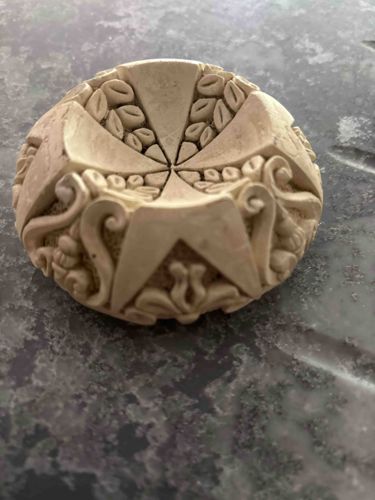
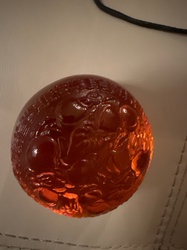
This item is a circular, hand-carved relief sculpture crafted from soapstone, exhibiting a pale, natural, cream-colored hue. Its prominent feature is a well-defined Maltese Cross at its center, with each of the four arms terminating in two points, creating the characteristic V-shape. The center of the cross is depressed, forming a star-like pattern where the arms meet. Surrounding the Maltese Cross, and filling the negative space within the circular form, is intricate floral or foliate ornamentation. This decoration consists of rows of stylized leaves, each individual leaf element deeply carved and uniformly shaped, contributing to a rich texture. Further out, towards the edges of the circular piece, the carving transitions into more elaborate scrollwork and swirling organic motifs, suggesting acanthus-like designs. The depth of the carving varies, creating a noticeable three-dimensional effect and shadows that highlight the intricate details. The material appears to be soapstone, as indicated by the context, giving it a smooth, somewhat matte finish. There are no immediately visible signs of significant damage such as chips or cracks, however, the surface shows a slight accumulation of dust or debris in the deeper crevices, particularly within the leaf patterns, suggesting a lack of recent cleaning or handling. There are no discernible maker's marks, signatures, or stamps evident in the provided image. The style of carving, particularly the stylized foliage and scrollwork coupled with the Maltese Cross, might suggest an older piece, potentially 19th or early 20th century, but without further context or markings, a precise age is difficult to ascertain. The craftsmanship appears to be of good quality, with precise lines and consistent depth in the carving, indicating a skilled hand.
AI Appraisal Report
Based on my visual examination of the provided image, this circular soapstone relief carving, featuring a Maltese Cross surrounded by intricate floral and scrollwork, appears to be in good overall condition. There are no obvious chips or cracks, which is positive for soapstone, a relatively soft material. The slight dust accumulation in the crevices suggests it hasn't been recently cleaned or handled extensively, but this poses no condition issue.
Authenticity, solely from an image, is limited. While the carving style suggests a potential 19th or early 20th-century origin, without provenance documentation, a maker's mark, or in-person inspection, a definitive age and origin cannot be asserted. The craftsmanship appears skilled, with consistent depth and precise lines, which is typical of well-executed historical or decorative carvings.
In terms of market conditions, decorative soapstone carvings of this type generally appeal to collectors interested in traditional decorative arts, religious iconography, or unique sculptural pieces. While not exceptionally rare, the quality of carving and the attractive design contribute to its desirability. Demand for such pieces is steady but not particularly high, placing it in a niche market.
Factors impacting value include its age (if verifiable as older), the skill of the carver, and its condition. The lack of a clear provenance or artist attribution limits its upper value. For full authentication and to ascertain its true age, a thorough in-person examination would be crucial to assess tool marks, patination, and material characteristics more precisely. Scientific testing might be needed for definitive dating.
Considering these factors, I estimate the appraisal value to be in the range of $250-400.