AI estimate as of December 10, 2025 · verify with a professional before acting
AI-Generated · Verify before acting
Everything on this page is generated by AI for informational purposes only. AI can make mistakes — the AI may misidentify items or misattribute them (artist, maker, brand, designer, origin, era). This is not an official valuation and should not be used for insurance, sale, tax, estate, legal, or lending purposes — or any decision requiring a certified appraisal. It is not an authoritative claim about any person, brand, or rights holder — do not share or rely on it as a factual statement about a third party. Always consult qualified professionals before making financial decisions.
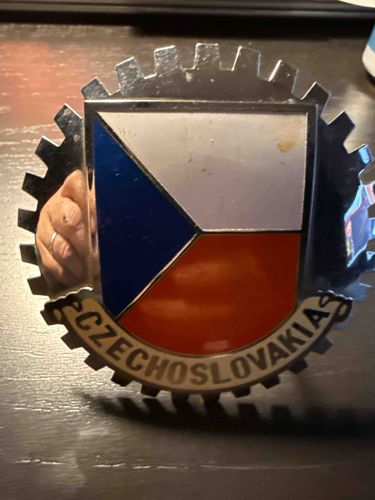
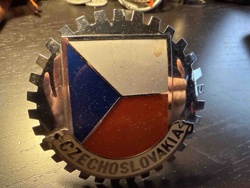
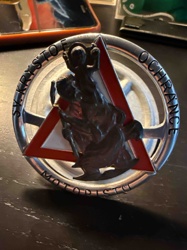
This item is a vintage emblem or badge, likely intended for a vehicle (such as a car or motorcycle) or potentially as a collectible pin. It features a central shield design, mirroring the national flag of Czechoslovakia before its dissolution, with a blue triangle on the left, a white field on the top right, and a red field on the bottom right. The colors appear to be enameled or painted into recessed areas of the central shield. The shield is set against a background shaped like a cogwheel or gear, which is crafted from a reflective, silver-toned metal, possibly chrome-plated brass or another polished alloy. The cogwheel design suggests a connection to industry, engineering, or perhaps a motoring club. Along the bottom curve of the cogwheel, the word "CZECHOSLOVAKIA" is prominently displayed in raised, gold-toned lettering, contrasting against a darker background within that section. The overall construction appears solid, with fine detailing in the raised letters and the sharp edges of the gear teeth. Visible condition issues include minor surface wear and some light spotting or discoloration on the white enamel field, indicative of age and past handling. The reflective surface of the metal shows some smudging and slight reflections of its surroundings. The item showcases typical craftsmanship for mid-20th century automotive badges, emphasizing durability and clear national representation. Its estimated age would be prior to 1993, when Czechoslovakia ceased to exist, likely placing it in the post-WWII to late 1980s period. No specific maker's marks or signatures are immediately discernible from the provided image.
AI Appraisal Report
Based on my visual examination of the provided image, this vintage Czechoslovakia emblem/badge appears to be an authentic piece from the mid-20th century, likely pre-1993. The design, featuring the Czechoslovakian flag within a cogwheel motif and the raised 'CZECHOSLOVAKIA' lettering, is consistent with automotive or club badges from that era. The general condition shows minor surface wear, some light spotting on the white enamel, and typical smudging on the reflective metal, all indicative of age and past use rather than significant damage. The colors retain good vibrancy.
In terms of market conditions, similar vintage automotive or national identity badges from defunct nations generally see moderate demand from collectors specializing in automobilia, national memorabilia, or historical artifacts. Comparables typically sell in the $30-$100 range, depending heavily on an item's specific condition, rarity, and material quality. While not exceedingly rare, badges from Czechoslovakia have a consistent collector base due to the country's historical significance and dissolution.
Factors impacting value include the solid construction and relatively good preservation of the enamel and metal. The clear legibility of the word 'CZECHOSLOVAKIA' is also a positive. Without being able to physically inspect the item, I cannot definitively confirm the material composition (e.g., specific alloy, type of enamel) or the exact method of attachment, which could slightly influence value. Full authentication would ideally require an in-hand examination to assess weight, material integrity, and search for any manufacturer's marks not visible in the image. Provenance documentation, though unlikely for such an item, would also add to its verifiable history. However, from the image, it presents as a genuine period piece.