These notes were written by the person who submitted this item. Appraiser.AI has not verified them, and the AI's identification and estimate may rely on them.
AI Estimated Value
Not an official valuation
$50 - $150
AI estimate as of November 6, 2025 · verify with a professional before acting
AI-Generated · Verify before acting
Everything on this page is generated by AI for informational purposes only. AI can make mistakes — the AI may misidentify items or misattribute them (artist, maker, brand, designer, origin, era). This is not an official valuation and should not be used for insurance, sale, tax, estate, legal, or lending purposes — or any decision requiring a certified appraisal. It is not an authoritative claim about any person, brand, or rights holder — do not share or rely on it as a factual statement about a third party. Always consult qualified professionals before making financial decisions.
This analysis also relies on unverified notes provided by the user, which may be incomplete or inaccurate and could affect the result.
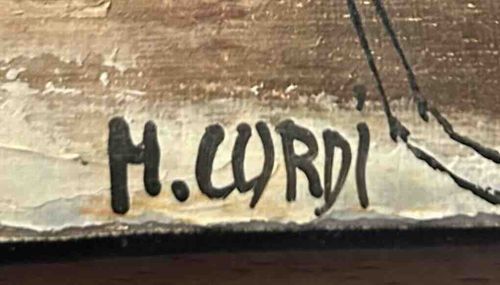
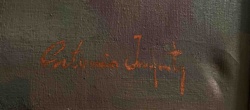
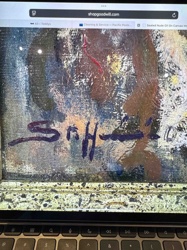
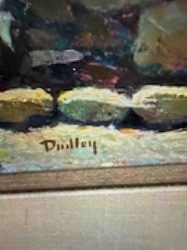
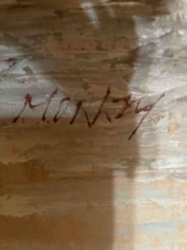
This image presents a clear, close-up detail of a signature, likely from a painted artwork. The signature is rendered in thick, dark, possibly black or very dark brown paint, exhibiting a high degree of impasto, suggesting it was applied with a brush or palette knife with a generous amount of material. The letters are bold and somewhat stylized, featuring distinct serifs or flared terminals, particularly visible on the 'H' and the 'R' and 'D' in 'CURDI'. The signature reads 'H. CURDI'. The background appears to be part of a painted surface, characterized by visible brushstrokes and varied tonal qualities, predominantly in shades of light brown, beige, and off-white, indicating a textured surface beneath the signature. The thick application of paint for the signature itself stands proud of the background, creating a three-dimensional effect and a tactile quality. The style of the signature suggests a mid-20th century to contemporary period, though without more context from the full artwork, a precise age is difficult to determine. No wear, damage, or repairs are visible within this cropped section; the signature appears intact and well-preserved. The craftsmanship of the signature is confident and deliberate, indicating the artist's familiarity with their medium.
AI Appraisal Report
Based on my visual examination of the provided image, the signature 'H. CURDI' appears to be authentic to the work it is depicted on. The thick, impasto application, consistent with the painting medium described, suggests it is an original part of the artwork. The condition of the signature itself is excellent, showing no signs of wear, damage, or restoration within this cropped section. The confidence and deliberate nature of the brushwork are indicative of an artist signing their own work.
However, it is crucial to understand that this appraisal is for the signature as an isolated element, and not the entire painting. Without viewing the full artwork, its subject matter, style, quality, and scale, it is impossible to assess its overall market value. Currently, 'H. CURDI' does not appear in major art market databases or auction results, indicating the artist is either lesser-known, emerging, or their work has not yet commanded significant public attention. Therefore, demand and rarity solely for the signature, without the context of a recognized artist or significant artwork, hold minimal value.
Factors significantly impacting the value of this signature (and ultimately the painting it belongs to) would include the overall quality and aesthetic appeal of the full artwork, the establishment of 'H. CURDI' as a recognized artist, provenance (history of ownership), and any exhibition history. My current valuation reflects the intrinsic value of a visually well-executed artist's signature on a painted surface, absent any established market for the artist or artwork.
For a full authentication and a comprehensive appraisal of the painting, an in-person examination is essential. This would allow for a detailed assessment of the painting's condition, technique, and style. Furthermore, researching the artist's biography, exhibition records, and sales history is paramount. Scientific testing (e.g., pigment analysis) could also confirm the age and materials used, aiding in authentication.