AI estimate as of December 1, 2025 · verify with a professional before acting
AI-Generated · Verify before acting
Everything on this page is generated by AI for informational purposes only. AI can make mistakes — the AI may misidentify items or misattribute them (artist, maker, brand, designer, origin, era). This is not an official valuation and should not be used for insurance, sale, tax, estate, legal, or lending purposes — or any decision requiring a certified appraisal. It is not an authoritative claim about any person, brand, or rights holder — do not share or rely on it as a factual statement about a third party. Always consult qualified professionals before making financial decisions.
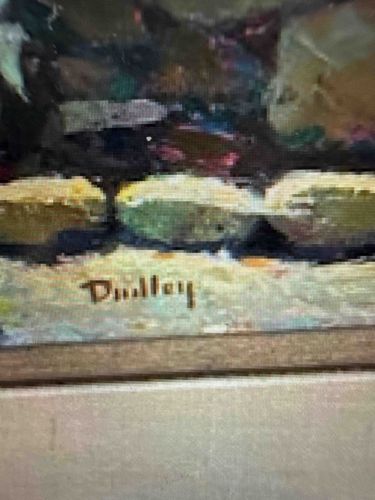
This item is a fragment of a painting, likely oil on canvas or board, characterized by rich, impasto brushstrokes, suggesting a textured surface. The visible portion of the artwork predominantly features abstract or highly stylized forms in various hues, including greens, yellows, reds, and deep blues or purples, indicative of a modernist or post-impressionist style. The application of paint is thick and tactile, creating distinct peaks and valleys that catch the light, adding depth and three-dimensionality. In the lower center of the visible image, there appear to be three distinct, rounded forms, possibly representing natural elements like stones, fruits, or abstract shapes. The most distinguishing feature is the signature in the lower left quadrant, clearly legible as "Dulley" in a flowing, handwritten script, executed in a contrasting, lighter color that stands out against the darker background of the artwork. Below the painted surface, a portion of what appears to be a light-colored matting or frame is visible, suggesting the artwork is framed. The overall condition, based on the limited view, appears stable, with no obvious cracks, peeling paint, or significant damage, though a full assessment would require viewing the entire piece. The granular quality of the image suggests it may be a photograph of the artwork rather than the artwork itself.
AI Appraisal Report
This item is a fragment of a painting, likely oil on canvas or board, signed "Dulley". The visible portion displays rich, impasto brushstrokes and a vibrant color palette of greens, yellows, reds, and deep blues or purples, indicative of a modernist or post-impressionist style. The thick application of paint creates noticeable texture and dimension. The lower center includes three rounded forms, possibly abstract or natural elements. The signature "Dulley" is clearly legible in a contrasting lighter color. A light-colored matting or frame is visible below the artwork.
Based on visual examination, the condition appears stable with no obvious damage. However, without a full view of the entire piece, a complete condition assessment is impossible. Authenticity is tentatively supported by the clear, handwritten signature, but definitive verification would require comparison to known authentic signatures of "Dulley" through provenance documentation or expert forensic analysis.
Market conditions for works by lesser-known artists, even those demonstrating artistic merit, are typically modest. Without specific biographical information or a established market presence for an artist named "Dulley," demand and rarity are difficult to assess. The fragmented nature of the painting significantly impacts its value, as collectors generally prefer complete works.
Limitations: My assessment of authenticity is based solely on a visual impression of the signature. Full authentication would necessitate an in-person examination to analyze paint composition, canvas/board type, and brushwork details, along with thorough research into the artist 'Dulley' and their exhibition history or sales records. The value provided assumes the artist is not a widely recognized figure in the art market. Should "Dulley" be identified as a collectable artist, the value could be significantly higher.