AI estimate as of September 10, 2025 · verify with a professional before acting
AI-Generated · Verify before acting
Everything on this page is generated by AI for informational purposes only. AI can make mistakes — the AI may misidentify items or misattribute them (artist, maker, brand, designer, origin, era). This is not an official valuation and should not be used for insurance, sale, tax, estate, legal, or lending purposes — or any decision requiring a certified appraisal. It is not an authoritative claim about any person, brand, or rights holder — do not share or rely on it as a factual statement about a third party. Always consult qualified professionals before making financial decisions.
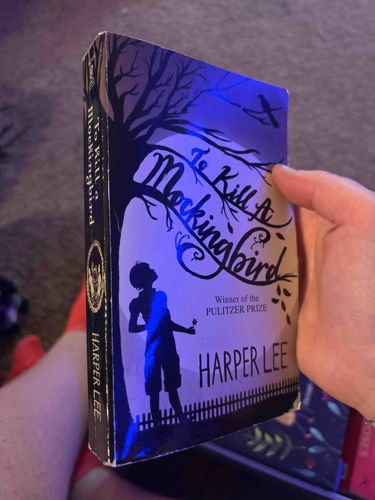
This item is a paperback copy of the novel 'To Kill a Mockingbird' by Harper Lee. The book features a softcover binding typical of paperback editions. The front cover design is predominantly lavender or light purple, with a stylized black silhouette of a large, gnarled tree dominating the upper portion. Below the tree, a silhouetted figure, likely depicting a young Scout Finch, stands on a dark, silhouetted fence line, looking upwards. The title 'To Kill A Mockingbird' is prominently written in a decorative, flowing script, with 'Mockingbird' being particularly large and ornate. Below the title, the phrase 'Winner of the Pulitzer Prize' is visible, followed by the author's name, 'HARPER LEE', in a larger, bolder sans-serif font. The back cover is not visible, but the spine is dark, possibly black, with the title 'To Kill a Mockingbird' written vertically, and 'HARPER LEE' also vertically oriented towards the bottom. The condition of the book appears to be used, with visible wear along the edges and corners of the cover, particularly at the top and bottom of the spine, indicating minor creasing and some chipping or rubbing of the paper. There is a noticeable bluish-purple glare across the front cover, likely from external lighting. The binding appears intact despite the wear. This specific edition's cover art, featuring the silhouette and script, suggests a modern reprint, likely from the late 20th or early 21st century, rather than a first or early edition. The craftsmanship is typical of mass-produced paperback novels.
AI Appraisal Report
Based on my visual examination of the provided image, this is a paperback copy of 'To Kill a Mockingbird' by Harper Lee. The cover art, featuring the lavender background, silhouetted tree and figure, and decorative script, strongly indicates a modern mass-market paperback reprint, likely from the late 20th or early 21st century. This is not a first edition or an early collectible edition. The craftsmanship is typical of mass-produced paperbacks.
From the image, the condition appears to be 'used'. There is visible wear along the edges and corners of the cover, particularly at the top and bottom of the spine, indicating minor creasing, chipping, and rubbing. While the binding appears intact, these cosmetic issues downgrade its condition. The bluish-purple glare across the front cover is incidental and does not affect the book's value.
In terms of market conditions, later printings of 'To Kill a Mockingbird' in paperback format are widely available. There is significant supply on the market for this particular edition or similar reprints. Demand is consistent for general reading copies, but there is no rarity associated with this specific edition. Comparables on online marketplaces and in used bookstores typically range from $3 to $8, depending on condition and seller. The extensive availability and non-collectible nature of this reprint significantly impact its value, keeping it firmly in the used book market price range.
It is important to note that without physical inspection, I cannot confirm the presence of any internal markings, foxing, water damage, or binding issues not visible from the exterior. Full authentication of any book's exact printing and edition always benefits from in-person examination, precise bibliographic comparisons, and, for rare items, provenance documentation. However, for a common paperback like this, the visual cues are sufficient to determine its non-collectible status.