These notes were written by the person who submitted this item. Appraiser.AI has not verified them, and the AI's identification and estimate may rely on them.
AI Estimated Value
Not an official valuation
$150-250
AI estimate as of November 28, 2025 · verify with a professional before acting
AI-Generated · Verify before acting
Everything on this page is generated by AI for informational purposes only. AI can make mistakes — the AI may misidentify items or misattribute them (artist, maker, brand, designer, origin, era). This is not an official valuation and should not be used for insurance, sale, tax, estate, legal, or lending purposes — or any decision requiring a certified appraisal. It is not an authoritative claim about any person, brand, or rights holder — do not share or rely on it as a factual statement about a third party. Always consult qualified professionals before making financial decisions.
This analysis also relies on unverified notes provided by the user, which may be incomplete or inaccurate and could affect the result.
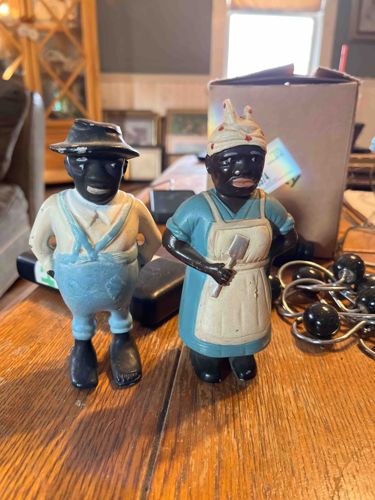
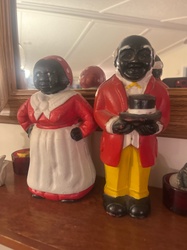
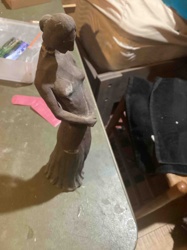
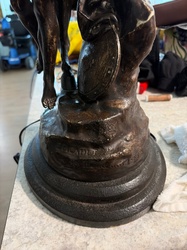
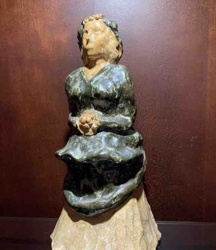
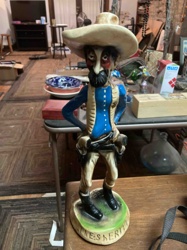
This pair of cast iron statues depicts two African-American figures, likely representing a male farmer and a female cook or domestic worker, dressed in traditional attire. The male figure is wearing a dark, wide-brimmed hat, a light-colored shirt, and light blue overalls, with dark shoes. His face is painted black with red lips and white eyes. The female figure is depicted with a head covering, possibly a kerchief or elaborate bonnet, adorned with red dots, a light blue dress or apron, and a white apron over it. She appears to be holding a small cleaver or knife in her right hand. Her face is also painted black with red lips and white eyes. Both figures exhibit a somewhat stereotypical and caricatured representation common in 'black Americana' collectibles from the late 19th to mid-20th centuries. The material is visibly cast iron, indicated by the dark, heavy appearance and slight surface pitting common to painted metals of that era. The paint shows wear, chipping, and areas of loss, particularly on raised surfaces such as the man's hat brim, the woman's head covering, and their clothing, suggesting age and handling. The colors are muted, with a matte finish. There are no clearly discernible maker's marks or signatures visible in the provided images. These types of figurines were often produced in various sizes and poses, serving as decorative items, doorstops, or banks. Their estimated age would be mid-20th century, consistent with the style and materials. The craftsmanship appears to be industrial rather than artisanal, with molded forms and hand-painted details. Despite the wear, the overall integrity of the cast iron structures seems intact.
AI Appraisal Report
I've examined the provided images of this pair of cast iron African-American figural statues. Based on their stylistic elements, materials, and paint wear, I estimate their age to be mid-20th century, likely between the 1940s and 1960s. The figures represent stereotypical caricatures common in 'Black Americana' collectibles. The condition shows significant paint loss, chipping, and wear, consistent with age and handling. However, the underlying cast iron structure appears intact. Authenticity, based on visual examination alone, points to them being vintage decorative items from the period mentioned. Without physical inspection, I cannot confirm the exact casting method or paint composition, but the visible pitting and dark material strongly suggest cast iron.
Market conditions for such 'Black Americana' items are complex. While there is a collector base, values can fluctuate widely based on rarity, condition, and historical context. These particular figures, while depicting a male farmer and a female cook (or domestic worker), appear to be relatively common designs, limiting their rarity. The wear, while indicative of age, detracts from the aesthetic appeal and overall market value compared to pieces in pristine condition. There are numerous reproductions of similar items, and a physical inspection would be crucial to confirm they are indeed period pieces and not later copies. Examination of the casting seams, specific paint layers, and potential manufacturer's marks (even if faint) would be necessary for full authentication. Provenance, if available, would also significantly aid in verification. Given the visible condition, commonality of design, and the limitations of image-based appraisal, I would place the retail appraisal value for this pair between $150 and $250.