AI Appraisal Estimate

AI-generated estimates · not official valuations

From the user

What was submitted

Photo and notes provided by the user — not generated by AI

Submitted item photo
Submitted photo · June 18, 2026

User's notes

Heavy

AI analysis below

AI appraisal

AI analysis & estimate

AI-Generated · Verify before acting

Everything below is generated by AI for informational purposes only. AI can make mistakes — the AI may misidentify items or misattribute them (artist, maker, brand, designer, origin, era). This is not an official valuation and should not be used for insurance, sale, tax, estate, legal, or lending purposes — or any decision requiring a certified appraisal. It is not an authoritative claim about any person, brand, or rights holder — do not share or rely on it as a factual statement about a third party. Always consult qualified professionals before making financial decisions.

Note

This analysis also relies on unverified notes provided by the user, which may be incomplete or inaccurate and could affect the result.

Read the full disclaimer

AI Identification

·Not independently authenticated·Verify before acting

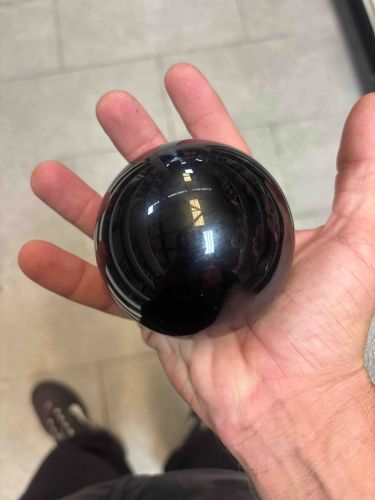
Polished Black Obsidian Scrying Sphere

Lapidary Art and Curios

AI Estimated Value

·Not an official valuation·Verify before acting

$45.00 - $75.00

As of June 18, 2026

AI Item Analysis

·AI can make mistakes·Verify before acting
This item is a perfectly spherical, highly polished orb fashioned from deep black volcanic glass, commonly known as obsidian. Based on the scale provided by the human hand, the sphere measures approximately 60 to 70 millimeters in diameter. The object possesses an exceptionally smooth, mirror-like finish that reflects surrounding light fixtures with sharp clarity, indicating high-quality lapidary craftsmanship and fine-grit polishing. Obsidian is a natural glass formed by the rapid cooling of silica-rich lava; as such, this piece is opaque and lacks the internal crystalline structures found in quartz. The user notes that the item is 'heavy,' which is consistent with the dense nature of solid obsidian. There are no visible maker's marks, signatures, or stamps, which is typical for such decorative or metaphysical objects. The condition appears excellent with no major chips, cracks, or fractures visible to the naked eye. However, close inspection of the reflected light reveals very fine surface micro-scratches, likely from handling or movement against hard surfaces. Black obsidian has been utilized for centuries, notably by the Aztecs for mirrors and by Renaissance-era occultists like John Dee for 'scrying.' This piece likely dates from the late 20th to early 21st century, falling into the category of modern lapidary arts intended for decorative use, meditation, or as a focal point for divination practitioners.
AI Appraisal Report

·AI can make mistakes·Verify before acting
Based on my examination of the 60-70mm black obsidian sphere, I have assessed it as a high-quality example of modern lapidary work. The item displays a superior mirror-like finish, confirming high-grit polishing techniques. The 'heavy' weight reported is consistent with natural volcanic glass (approx. 2.4 specific gravity). Condition is excellent; the micro-scratches noted are typical of obsidian’s Mohs hardness (5–5.5) and do not significantly detract from its aesthetic appeal. Market conditions for obsidian scrying orbs are stable, driven primarily by the metaphysical and 'Cabinet of Curiosities' decor markets. This piece is not a rare antiquity, such as a pre-Columbian mirror or a 16th-century artifact, but rather a contemporary production. Comparable sales for 60-70mm polished spheres at retail range from $40 to $85, while secondary market auctions typically realize $30 to $50. The lack of inclusions or 'gold sheen' (iris obsidian) places this in the standard 'midnight' variety category. Value is limited by the lack of provenance linking it to a specific artist or historic collection. Factors increasing value would include a custom-carved stand or documentation of origin. Documentation and scientific testing are critical for full authentication: while this appears to be natural glass, an in-person examination using a polariscope would be required to distinguish it from black lead glass or synthetic slag. Furthermore, microscopic analysis of the surface would be necessary to confirm the absence of modern machine-lapping marks if historical antiquity were claimed. As an image-based appraisal, this value assumes the material is natural, non-irradiated obsidian.

Get your items appraised

Instant estimates of your treasures with AI-powered appraisals

Browse More Appraisals