Vintage Chinese Gemstone Bonsai 'Jade Tree'
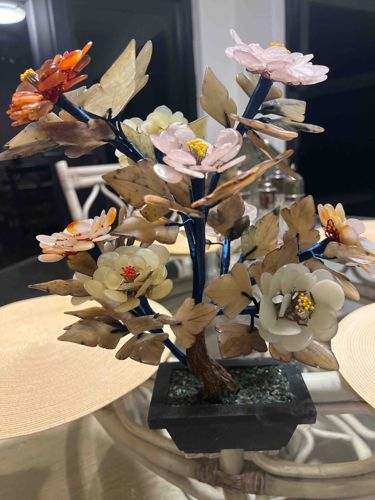
This is a decorative Chinese gemstone bonsai tree, commonly referred to as a 'Jade Tree.' The piece features various carved semi-precious stones including what appears to be rose quartz, carnelian, and celadon jade or soapstone. The blossoms are meticulously assembled with individual stone petals, some with beaded yellow stamen centers. The leaves are carved from a tan-to-brown shaded stone, possibly serpentine or a lower grade of bowenite, with serrated edges to mimic natural foliage. The structure is built upon a central wire armature wrapped in dark navy silk or rayon thread, allowing for the flexible positioning of the branches. The tree is rooted in a rectangular matte black ceramic or stone planter filled with green stone chips as 'soil'. This style of lapidary work flourished in the mid-20th century (c. 1950s-1970s) for the export market. The craftsmanship shows attention to detail in the thinning of the petals and the organic curvature of the trunk. Condition-wise, the piece appears largely intact, though there is a heavy layer of surface dust, and some petals may have slight chips or minor misalignments typical of vintage wire-constructed pieces. There are no readily visible maker's marks, which is common for these artisanal workshop pieces.
AI-Generated Appraisal Disclaimer
Estimated Value
$150 - $250
Basic Information
Category
Asian Decorative Arts / Lapidary Art
Appraised On
February 6, 2026
Estimated Value
$150 - $250
Item Description
This is a decorative Chinese gemstone bonsai tree, commonly referred to as a 'Jade Tree.' The piece features various carved semi-precious stones including what appears to be rose quartz, carnelian, and celadon jade or soapstone. The blossoms are meticulously assembled with individual stone petals, some with beaded yellow stamen centers. The leaves are carved from a tan-to-brown shaded stone, possibly serpentine or a lower grade of bowenite, with serrated edges to mimic natural foliage. The structure is built upon a central wire armature wrapped in dark navy silk or rayon thread, allowing for the flexible positioning of the branches. The tree is rooted in a rectangular matte black ceramic or stone planter filled with green stone chips as 'soil'. This style of lapidary work flourished in the mid-20th century (c. 1950s-1970s) for the export market. The craftsmanship shows attention to detail in the thinning of the petals and the organic curvature of the trunk. Condition-wise, the piece appears largely intact, though there is a heavy layer of surface dust, and some petals may have slight chips or minor misalignments typical of vintage wire-constructed pieces. There are no readily visible maker's marks, which is common for these artisanal workshop pieces.
Get Your Items Appraised
Instant estimates of your treasures with AI-powered instant appraisals