AI estimate as of November 11, 2025 · verify with a professional before acting
AI-Generated · Verify before acting
Everything on this page is generated by AI for informational purposes only. AI can make mistakes — the AI may misidentify items or misattribute them (artist, maker, brand, designer, origin, era). This is not an official valuation and should not be used for insurance, sale, tax, estate, legal, or lending purposes — or any decision requiring a certified appraisal. It is not an authoritative claim about any person, brand, or rights holder — do not share or rely on it as a factual statement about a third party. Always consult qualified professionals before making financial decisions.
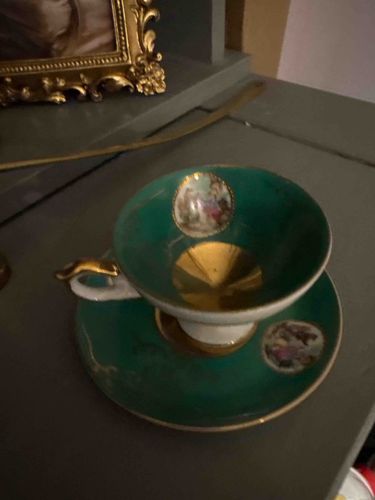
This appears to be a vintage or antique porcelain cup and saucer set, characterized by its vibrant emerald green exterior and heavily gilded accents. The set consists of a teacup or coffee cup and a matching saucer. Both pieces feature a striking emerald green glaze on their outer surfaces and significant gold detailing. The interior of the cup is particularly ornate, with a large, faceted-like gold application at the bottom, suggesting a highly decorative intent rather than purely functional everyday use. The handle of the cup is also gilded, showcasing an elegant, curved design.
A notable decorative element on both the cup (inside near the rim) and the saucer are small, round figural medallions. These medallions depict what appear to be pastoral or romantic scenes with multiple figures, possibly in a Rococo or Georgian style, rendered in delicate colors. The borders of these medallions are also highlighted with gold. The rim of the saucer and the lip of the cup have fine gold banding, adding to the luxurious aesthetic. The inner part of the cup, above the gold base, is white, creating a contrast with the green exterior. The overall design suggests a period of manufacturing when elaborate ornamentation and rich colors were highly valued in tableware. There are no obvious signs of significant damage such as chips or cracks, but some wear to the gilt or minor surface abrasions, consistent with age and use, might be present. The specific maker's marks or signatures are not visible in the provided image.
AI Appraisal Report
Upon visual examination of the provided image, this Emerald Green Gilt Porcelain Cup and Saucer Set presents as a fine example of decorative porcelain, likely dating from the late 19th to early 20th century, given its elaborate ornamentation and rich coloring. The overall condition appears to be very good; I observe no obvious chips, cracks, or significant losses. There might be some minor wear to the gilding, which is consistent with age and gentle use, contributing to its authentic vintage or antique character rather than detracting significantly from its value.
From the image, its authenticity appears strong, based on the detailed hand-painting, intricate gilding, and the style of the figural medallions. However, it's crucial to state that full authentication requires in-person examination. I would need to physically inspect for maker's marks, the quality of the paste, and the application of glazes and gilding to confirm its origin and period unequivocally. Provenance documentation, if available, would significantly enhance authenticity and value.
Market conditions for high-quality antique porcelain remain stable, with a particular demand for exquisitely decorated and well-preserved pieces. Similar sets with rich ornamentation, especially those showcasing figural scenes and extensive gilding, tend to perform well. The emerald green color is quite striking and adds to its appeal. Rarity is difficult to ascertain without knowing the specific manufacturer, but based purely on aesthetic appeal and apparent craftsmanship, it would attract collectors of decorative arts and fine porcelain.
Factors significantly impacting value include its excellent apparent condition, elaborate design, and decorative allure. Ultimately, a confirmed manufacturer (e.g., Dresden, Meissen, or Sevres-style pieces) would greatly influence its specific market position. Without a physical inspection to verify marks, paste quality, and the absence of restorations, the assessment of authenticity and precise vintage remains an informed estimate based solely on visual cues from the image.