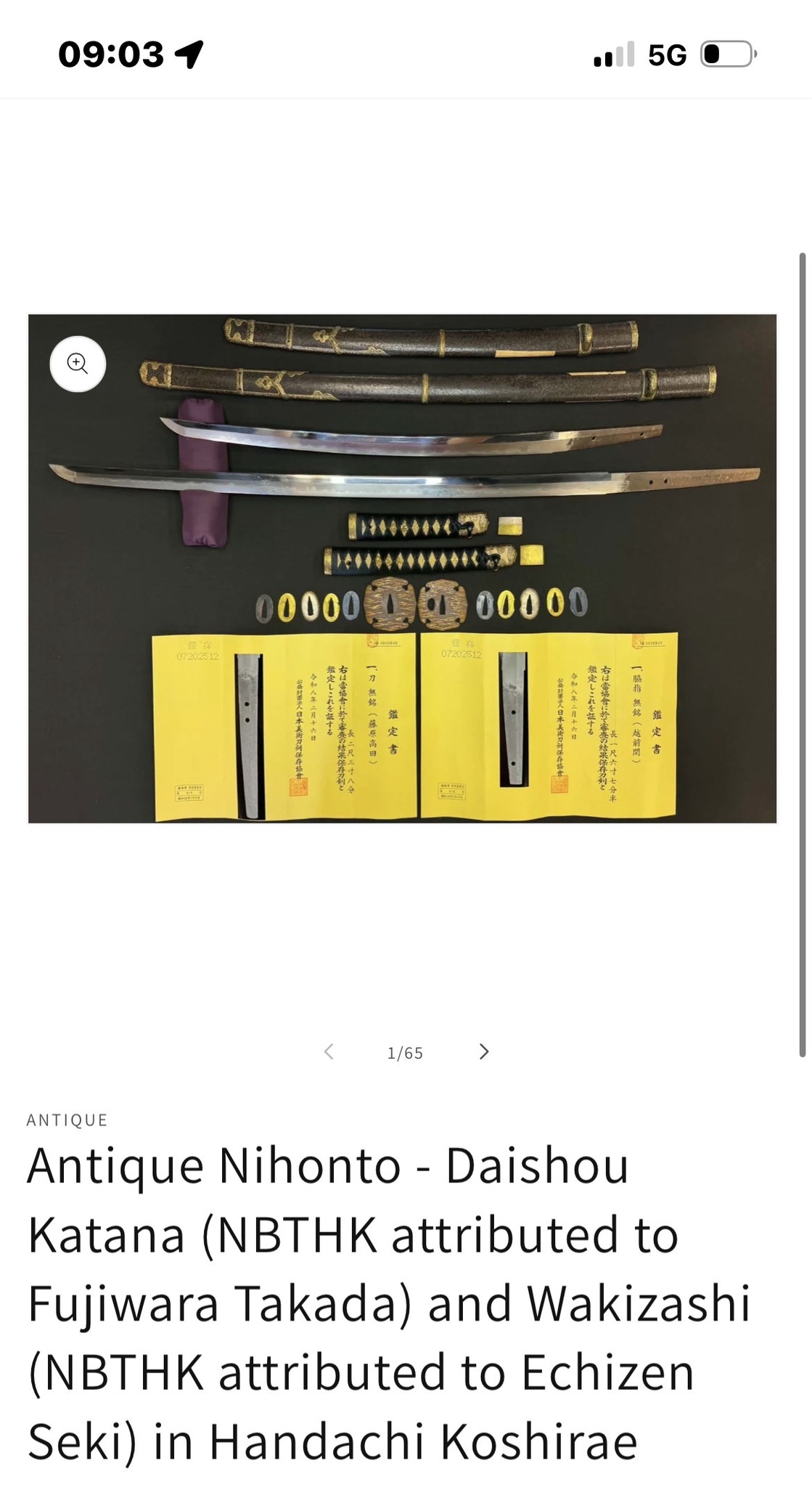
Antique Nihonto - Daishou Katana (NBTHK attributed to Fujiwara Takada) and Wakizashi (NBTHK attributed to Echizen Seki) in Handachi Koshirae
These notes were written by the person who submitted this item. Appraiser.AI has not verified them, and the AI's identification and estimate may rely on them.
AI Estimated Value
Not an official valuation
$6,500 - $9,500
AI estimate as of September 8, 2026 · verify with a professional before acting
AI-Generated · Verify before acting
Everything on this page is generated by AI for informational purposes only. AI can make mistakes — the AI may misidentify items or misattribute them (artist, maker, brand, designer, origin, era). This is not an official valuation and should not be used for insurance, sale, tax, estate, legal, or lending purposes — or any decision requiring a certified appraisal. It is not an authoritative claim about any person, brand, or rights holder — do not share or rely on it as a factual statement about a third party. Always consult qualified professionals before making financial decisions.
This analysis also relies on unverified notes provided by the user, which may be incomplete or inaccurate and could affect the result.
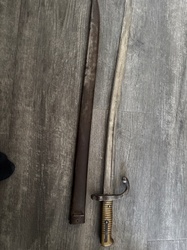
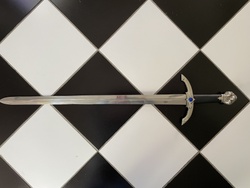
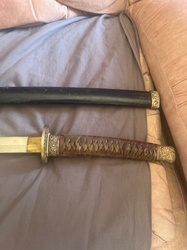
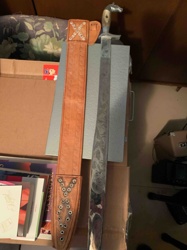
The provided image displays a complete Japanese daishou sword set, featuring two distinct blades comprising a longer katana and a shorter wakizashi, accompanied by their respective scabbards (saya), storage bags, tsuka handles, various tsuba guards, mounting hardware, and two yellow certification papers bearing red stamps. The steel blades exhibit visible curved profiles, polished jigane surfaces, and tangs (nakago) perforated with mounting holes. The mountings feature dark textured finishes highlighted with metallic fittings and gold-toned accents. The accompanying yellow papers display Japanese kanji text alongside imagery of sword tangs. The owner's unverified notes attribute this antique nihonto daishou set to Fujiwara Takada for the katana and Echizen Seki for the wakizashi, complete with NBTHK attributions and Handachi koshirae mountings. However, this specific attribution and the paper certificates are unverified from the visual evidence alone, as the fine details of the inscriptions and the physical blade structures cannot be independently authenticated through the photograph. The items display an appearance consistent with traditional Japanese swordsmanship artifacts, showing standard craftsmanship details including shaped guards, wrapped handles, and polished steel surfaces. Condition issues cannot be fully determined due to the resolution and distance of the image, but the pieces generally appear well-preserved and complete with matched components characteristic of traditional daishou mountings.
AI Appraisal Report
Based on what I can see in the photograph, I have evaluated this complete Japanese daishou sword set, which includes both a katana and wakizashi with scabbards, handles, tsuba guards, and yellow certification papers. Per user submission, the pieces are attributed to Fujiwara Takada for the katana and Echizen Seki for the wakizashi, housed in Handachi koshirae mountings. I can't verify from a photo alone whether these attributions are accurate, as the fine details of the steel grain, inscriptions, and paper certificates cannot be independently authenticated through the image. The items appear visually complete and well-preserved with matching components, which forms the basis for this estimate. My valuation range of $6,500 to $9,500 assumes the owner's attributions and accompanying papers are correct upon physical inspection. General market demand for traditional nihonto daishou sets with koshirae remains steady among collectors of Japanese swordsmanship artifacts. However, if physical inspection reveals the set to be a reproduction, modern replica, or copy rather than antique nihonto, the value would decrease significantly, typically dropping to a range of $800 to $1,500 for decorative or replica pieces. To confirm authenticity and the validity of the attributions, I would need physical inspection, close-up examination of the tang inscriptions, paper verification by a qualified sword expert, and potentially specialized artifact evaluation.