AI estimate as of October 28, 2025 · verify with a professional before acting
AI-Generated · Verify before acting
Everything on this page is generated by AI for informational purposes only. AI can make mistakes — the AI may misidentify items or misattribute them (artist, maker, brand, designer, origin, era). This is not an official valuation and should not be used for insurance, sale, tax, estate, legal, or lending purposes — or any decision requiring a certified appraisal. It is not an authoritative claim about any person, brand, or rights holder — do not share or rely on it as a factual statement about a third party. Always consult qualified professionals before making financial decisions.
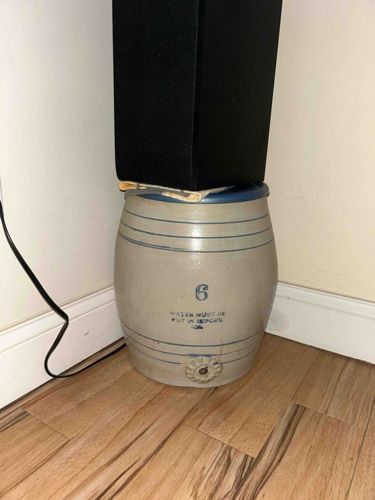
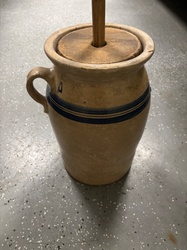
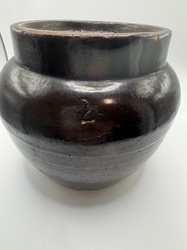
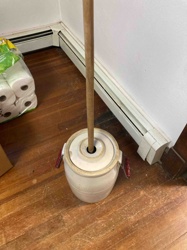
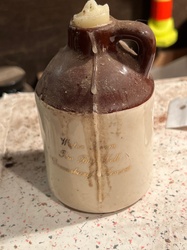
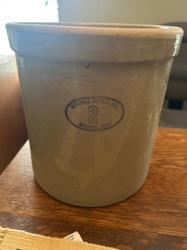
This item is an antique stoneware water cooler or crock, characterized by its ovoid, barrel-like shape. Made from light gray to beige salt-glazed stoneware, it features a smooth exterior with distinct horizontal cobalt blue bands encircling the body. There are at least five such bands visible, with two pairs of closely spaced lines near the top and bottom of the main body, and a single line just above the lower pair. The top rim is also colored with a darker, likely cobalt blue, glaze. A prominent '6' is stenciled in cobalt blue on the front, indicating its capacity, likely 6 gallons. Below the '6', there is stenciled text, also in cobalt blue, which appears to read 'WATER MUST BE PUT IN BEFORE' with an illegible word or two beneath it, likely a manufacturing or usage instruction. Near the base, there's an applied, raised stoneware rosette or floral medallion, which typically marks the location for a spigot. The stoneware appears to be in relatively good condition for its age, showing a uniform patina consistent with historical stoneware. There are no immediately visible cracks or large chips from the provided image, though the full surface is not exposed. The craftsmanship suggests a utilitarian piece from the late 19th or early 20th century, common for storing and dispensing liquids like water, cider, or vinegar. The material and construction indicate durability and a hand-crafted quality typical of the period.
AI Appraisal Report
Based on my visual examination of the provided image, this antique salt-glazed stoneware water cooler/crock presents as a fine example of utilitarian stoneware from the late 19th to early 20th century. The ovoid, barrel-like form, light gray-to-beige body, and distinct cobalt blue banding are all characteristic features of this period. The stenciled '6' indicating capacity (likely 6 gallons) and the partial stenciled instruction 'WATER MUST BE PUT IN BEFORE...' add significant historical and aesthetic appeal, often associated with manufacturers like Red Wing, Macomb, or Western Stoneware, though without clear maker's marks, this remains speculative. The applied stoneware rosette at the base for a spigot is also a desirable original feature.
From the image, the condition appears to be relatively good for its age, displaying a consistent, age-appropriate patina. I do not observe any immediate cracks, large chips, or repairs, which is a significant positive factor. Even minor flaws can considerably reduce value in the stoneware market. Stoneware with clear stenciling and vibrant cobalt decoration tends to command higher prices.
Market conditions for antique American stoneware remain stable, especially for desirable forms, good condition, and clear markings. Comparables with similar capacity, stenciling, and decoration from known manufacturers typically range between $300 and $700, depending heavily on provenance and exact condition. This piece, being a cooler rather than a simple crock, often has slightly higher demand due to its specific function and design.
Factors positively impacting value include the clear '6' stenciling, the decorative cobalt banding, and the generally good apparent condition. The partial, intriguing stenciled text also adds interest. Factors limiting the higher end of the range include the absence of a visible maker's mark and the illegible portion of the stenciled text, which prevents full identification and potential historical context. The main limitation in my full authentication and precise condition assessment is that this is based solely on an image. For full authentication, I would require an in-person examination to inspect for hairline cracks, chips not visible at this angle, repairs, and to verify the texture and glaze quality tactilely. Provenance documentation, if available, would also be invaluable for historical verification and could further enhance value. Scientific testing is not typically required for this type of item unless there are significant questions about its age or material composition.