AI Appraisal Estimate

AI-generated estimates · not official valuations

From the user

What was submitted

Photo and notes provided by the user — not generated by AI

Submitted item photo
Submitted photo · June 6, 2026

User's notes

No additional notes provided.

AI analysis below

AI appraisal

AI analysis & estimate

AI-Generated · Verify before acting

Everything below is generated by AI for informational purposes only. AI can make mistakes — the AI may misidentify items or misattribute them (artist, maker, brand, designer, origin, era). This is not an official valuation and should not be used for insurance, sale, tax, estate, legal, or lending purposes — or any decision requiring a certified appraisal. It is not an authoritative claim about any person, brand, or rights holder — do not share or rely on it as a factual statement about a third party. Always consult qualified professionals before making financial decisions.

Read the full disclaimer

AI Identification

·Not independently authenticated·Verify before acting

Mixed Collection of International Vintage Postage Stamps

Philatelic Collectibles (Postage Stamps)

AI Estimated Value

·Not an official valuation·Verify before acting

$5.00-$10.00

As of June 6, 2026

AI Item Analysis

·AI can make mistakes·Verify before acting
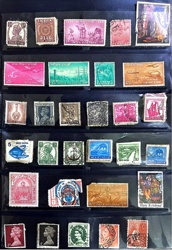
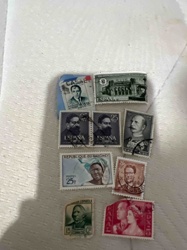
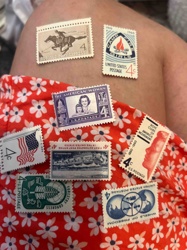
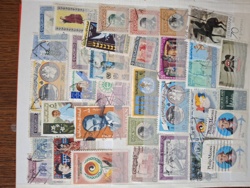
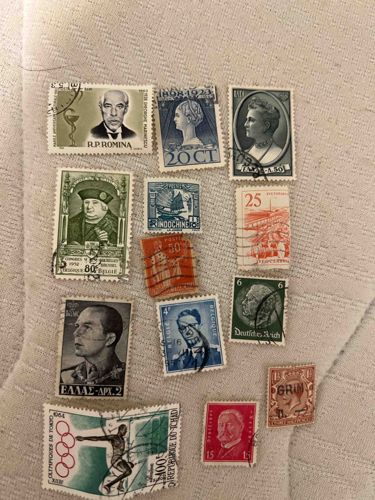
This is a diverse assortment of thirteen vintage postage stamps from various countries and eras, exhibiting a range of philatelic designs and historical periods. The collection includes notable issues such as a Romanian stamp honoring Gheorghe Marinescu (R.P. Romina), a Belgian stamp featuring a portrait of a male figure in a hat, an Indo-Chinese issue with a sailing vessel motif, and a 1964 Olympic Games commemorative from the Republic of Chad. Other visible stamps originate from Germany (Deutsches Reich), Greece (Ellas), and possibly Spain or South American regions (Indicated by 'GRIN' and 'CT' denominations). The stamps are printed on paper with typical perforated edges, though some show signs of careful cutting or slight edge wear. Color palettes range from monochromatic sepia and gray tones to vibrant greens, reds, and oranges. Many of the stamps bear black ink cancellation marks (postmarks), indicating they were used in circulation. Condition varies among the pieces; while some appear relatively well-preserved with sharp imagery, others show mild creasing, corner blunting, and faded pigmentation consistent with mid-20th-century paper ephemera. The collection spans approximately the late 1920s to the mid-1960s, showcasing diverse typographical styles, engraved portraits, and commemorative themes. This group serves as a representative cross-section of global postal history from the modern era.

AI Appraisal Report

·AI can make mistakes·Verify before acting
I have conducted a visual examination of this mixed philatelic collection comprising thirteen international stamps. The assembly includes common definitive and commemorative issues from Romania, Belgium, French Indo-China, Chad, Germany, and Greece, spanning roughly 1920 to 1965. Based on my assessment, the stamps appear to be authentic specimens of their respective eras, showing correct typography and period-appropriate color saturation. The condition ranges from fair to good; however, several examples exhibit significant corner blunting, heavy cancellation marks which obscure the designs, and 'hinge' remnants likely on the reverse. The 1964 Chad Olympic issue and the Romanian medical commemorative (Marinescu) are common tropes in philately with very high print runs. Market demand for this specific grouping is low, as these are 'packet' material stamps frequently found in beginner collections rather than rare varieties or high-value errors. The German 'Deutsches Reich' and Greek 'Ellas' pieces are standard circulation items from periods of high inflation or high volume, further limiting scarcity. My valuation reflects the bulk price of miscellaneous low-grade ephemera. Please note that this valuation is based solely on digital imagery. A definitive appraisal would require a physical inspection to check for watermark authenticity, paper density, perforation gauge measurements, and the integrity of the original gum (OG) on the reverse side. Scientific tools like UV light testing are necessary to detect repairs or re-gumming, and provenance documentation would be required for any item suspected to be a rare plate variety.

Get your items appraised

Instant estimates of your treasures with AI-powered appraisals

Browse More Appraisals