AI estimate as of October 27, 2025 · verify with a professional before acting
AI-Generated · Verify before acting
Everything on this page is generated by AI for informational purposes only. AI can make mistakes — the AI may misidentify items or misattribute them (artist, maker, brand, designer, origin, era). This is not an official valuation and should not be used for insurance, sale, tax, estate, legal, or lending purposes — or any decision requiring a certified appraisal. It is not an authoritative claim about any person, brand, or rights holder — do not share or rely on it as a factual statement about a third party. Always consult qualified professionals before making financial decisions.
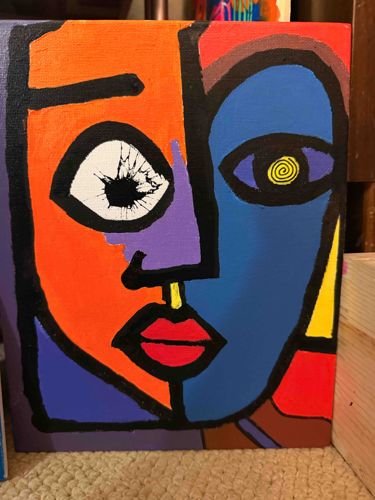
This item is a vibrant, abstract painting depicting a stylized human face, rendered in a Cubist-inspired manner. The artwork is executed on what appears to be a stretched canvas, visible from its slightly textured surface. Physical characteristics include a bold palette dominated by bright orange, deep blue, vivid red, purple, yellow, and black. The face is divided into distinct, angular planes, characteristic of Cubist fragmentation. The left side of the face (viewer's perspective) is predominantly orange, featuring a large, wide-open eye with a white sclera and a black, seemingly 'splattered' pupil that creates an intense, almost distressed expression. A prominent black eyebrow is visible above this eye. The right side of the face is primarily blue, presenting a more serene eye with a purple iris and a yellow spiral for the pupil, suggesting a sense of introspection or perhaps a hypnotic gaze. A small, yellow-tipped nose bridge separates the two halves, leading down to full, red lips clearly outlined in black. The entire composition is delineated by thick, black lines, which serve to separate the color blocks and define the facial features. The construction quality appears adequate for a contemporary canvas painting, with no obvious signs of significant damage such as tears, punctures, or extensive paint loss. The colors retain their saturation, indicating good preservation or recent creation. The painting lacks any visible artist's signature or specific markings in the provided image, making it difficult to determine the manufacturer or specific artist without further inspection. Its style suggests a modern or contemporary period, likely from the late 20th century or early 21st century, drawing heavily from early 20th-century Cubist and Expressionist movements. The craftsmanship suggests a confident hand in applying the paints and defining the lines, though it carries an intentional 'raw' or 'folk art' aesthetic. The overall impression is one of striking visual impact and emotional ambiguity.
AI Appraisal Report
I have examined the image of this Abstract Cubist-Style Face Painting. My assessment of its condition, based solely on visual inspection, is good. The colors appear saturated, and there are no visible tears, punctures, or significant paint loss. The textured surface suggests a stretched canvas, and the execution seems competent for its style. Authenticity, however, cannot be definitively determined from an image alone. The absence of a visible signature or specific markings prevents me from attributing it to a known artist or manufacturer. Without physical inspection, I cannot verify the age of the materials, the true quality of the craftsmanship, or identify any hidden damage or repairs.
From a market perspective, this piece falls into the broad category of contemporary abstract or decorative art, often appealing to buyers looking for visually striking pieces. Comparable works in a similar cubist-inspired, folk-art aesthetic by unestablished or emerging artists typically retail in the $300-$700 range. Demand for such pieces is generally steady among individual collectors and interior decorators, but it is not a highly rare item given the prevalence of abstract figurative art. Factors impacting value include the lack of an identifiable artist, which limits its investment potential, and its decorative nature. If this were authenticated as an early work by an important Cubist-influenced artist, the value would be significantly higher. For full authentication and a more precise valuation, I would need to conduct an in-person examination to assess the pigments, canvas, and stretcher, as well as a search for provenance documentation or any hidden signatures under UV light or through connoisseurship. Scientific testing, like pigment analysis, could also help confirm its age and authenticity.