These notes were written by the person who submitted this item. Appraiser.AI has not verified them, and the AI's identification and estimate may rely on them.
AI Estimated Value
Not an official valuation
$25-45
AI estimate as of July 12, 2025 · verify with a professional before acting
AI-Generated · Verify before acting
Everything on this page is generated by AI for informational purposes only. AI can make mistakes — the AI may misidentify items or misattribute them (artist, maker, brand, designer, origin, era). This is not an official valuation and should not be used for insurance, sale, tax, estate, legal, or lending purposes — or any decision requiring a certified appraisal. It is not an authoritative claim about any person, brand, or rights holder — do not share or rely on it as a factual statement about a third party. Always consult qualified professionals before making financial decisions.
This analysis also relies on unverified notes provided by the user, which may be incomplete or inaccurate and could affect the result.
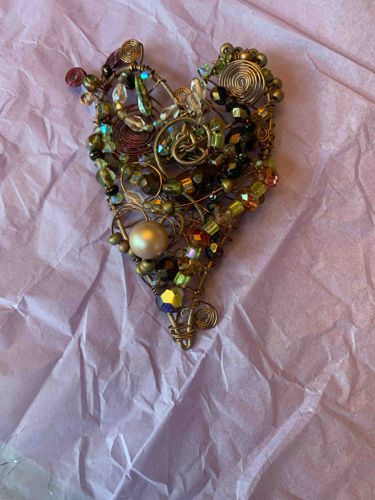
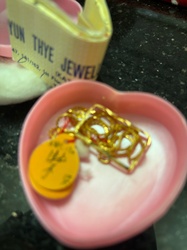
This is a whimsical, handcrafted brooch in the shape of a heart, predominantly featuring an array of wirework and various beads. The construction appears to be artisanal, likely made from copper or brass wire, which forms the heart's outline and intricate internal swirls, creating a cage-like structure. The wire exhibits a warm, antiqued gold or copper tone, suggesting either intentional patination or natural aging. Numerous beads of different shapes, sizes, and colors are intricately woven into and around this wire framework. There are clear faceted beads, various shades of green beads (some opaque, some translucent, and some iridescent), and darker, possibly black or deep brown, beads. A prominent large, smooth, light-colored bead, possibly a faux pearl or glass bead with a pearlescent finish, is situated towards the bottom left of the heart. Other beads include small, round metallic-looking ones and faceted beads that reflect different colors like yellow and purple depending on the light, indicating an iridescent or aurora borealis (AB) coating. The piece has a dense, three-dimensional quality due to the layering of wires and beads. The overall condition appears good, with no obvious signs of breakage or missing components, though the wire texture and color suggest it is not new, possibly indicating a vintage or vintage-inspired piece. The craftsmanship, while intricate, leans towards an organic, freeform style rather than precise, mass-produced jewelry. It lacks discernible maker's marks or signatures from the visible perspective. Given its style, it likely dates from the late 20th century to the early 21st century, fitting a bohemian or artistic jewelry aesthetic.
AI Appraisal Report
I have examined the provided images of this artisan wire-wrapped heart brooch. The piece exhibits a freeform, handcrafted style characteristic of bohemian or artistic jewelry, likely dating from the late 20th to early 21st century. The base metal appears to be a non-precious craft wire, such as copper or brass, which has been skillfully manipulated to form the heart structure. The embedded embellishments consist of various glass, plastic, and possibly faux pearl beads; the materials appear to be standard craft quality rather than precious gemstones or fine pearls. The condition is good for a piece of its type, with the wirework and bead settings intact, though showing an aged or intentionally antiqued patina. The value of such handcrafted, non-precious jewelry is primarily determined by its artistic merit, intricacy, and decorative appeal rather than its material components. The market for this style of vintage-inspired, unsigned artisan jewelry is active on platforms like Etsy and at craft fairs, but prices are generally modest. Rarity is difficult to ascertain as it is likely a one-of-a-kind piece, yet similar handcrafted items are widely available. A significant factor limiting the value is the absence of a known maker's mark and the use of non-precious materials. Please note, this appraisal is based solely on visual examination of images. A physical inspection would be necessary to test the metals and identify the specific types of beads used, which could slightly alter the valuation but is unlikely to reveal precious materials.