These notes were written by the person who submitted this item. Appraiser.AI has not verified them, and the AI's identification and estimate may rely on them.
AI Estimated Value
Not an official valuation
$250-400
AI estimate as of September 22, 2025 · verify with a professional before acting
AI-Generated · Verify before acting
Everything on this page is generated by AI for informational purposes only. AI can make mistakes — the AI may misidentify items or misattribute them (artist, maker, brand, designer, origin, era). This is not an official valuation and should not be used for insurance, sale, tax, estate, legal, or lending purposes — or any decision requiring a certified appraisal. It is not an authoritative claim about any person, brand, or rights holder — do not share or rely on it as a factual statement about a third party. Always consult qualified professionals before making financial decisions.
This analysis also relies on unverified notes provided by the user, which may be incomplete or inaccurate and could affect the result.
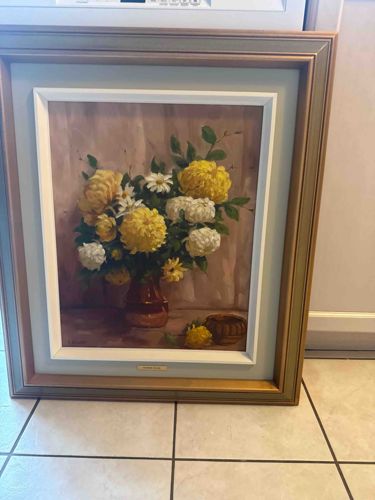
This item is a framed oil painting depicting a floral still life. The central focus is a vibrant arrangement of chrysanthemums and daisies, primarily in shades of yellow and white. The flowers are voluminous and textured, suggesting a certain mastery in brushwork to capture their forms. They are displayed in a reddish-brown, possibly ceramic or terracotta, vase with a glossy finish. The background appears to be a muted, light brownish-pink or tan fabric, possibly a draped curtain or wall, which provides a soft contrast to the foreground elements. On the surface below the vase, which resembles a wooden tabletop, there is an additional fallen yellow flower with a small woven basket or decorative element to the right. The color palette leans towards warm tones, with dominant yellows, whites, greens for foliage, and earthy reds and browns. The painting is housed within a multi-layered frame. An inner white or light cream mat provides a border around the artwork itself, followed by a light blue-grey or sage green fillet, and then a larger, textured gold-toned wooden frame. The outermost frame appears to be a simple, flat gold-colored molding. There doesn't appear to be any visible signature or artist's mark in the provided image, though a small rectangular plaque or label is affixed to the bottom center of the inner mat, which might contain the title or artist's name, but it is unreadable. The overall condition appears good, with no obvious signs of damage, cracks, or significant wear to the painting or frame, suggesting it has been well-maintained. Its style is traditional and realistically rendered, likely dating from the mid to late 20th century, a common period for decorative floral works.
AI Appraisal Report
Based on my visual examination of the provided image, this is a framed oil painting depicting a floral still life of chrysanthemums and daisies. The brushwork appears competent, capturing the volume and texture of the flowers effectively. The color palette is warm and appealing, and the composition is traditional. The overall condition looks good, with no obvious signs of damage to the canvas or paint layer, and the frame also appears well-maintained. The multi-layered framing itself adds to the presentation value.
Market conditions for decorative, unsigned floral still life paintings from the mid to late 20th century are generally stable but do not command high prices unless attributed to a known artist. While the quality is good, the lack of a visible signature significantly impacts its value. Comparables for similar decorative works by unidentified artists typically fall within a modest range, primarily driven by aesthetic appeal and condition rather than artistic provenance or rarity. Works of this nature are quite common, hence rarity is not a factor elevating its value.
Limitations in authenticity verification are significant. Without a visible signature, artist's mark, or provenance documentation, the artist remains unknown. An in-person examination would be crucial to assess the true medium (confirming oil), condition of the canvas and paint, frame integrity, and for any hidden signatures or labels on the reverse. Scientific testing (e.g., pigment analysis) could help confirm age, but is generally cost-prohibitive for pieces in this value range. The small plaque at the bottom is unreadable in the image and would need close inspection. For these reasons, my appraisal value is based purely on its decorative merit and condition as a generic piece of art.