AI estimate as of November 16, 2026 · verify with a professional before acting
AI-Generated · Verify before acting
Everything on this page is generated by AI for informational purposes only. AI can make mistakes — the AI may misidentify items or misattribute them (artist, maker, brand, designer, origin, era). This is not an official valuation and should not be used for insurance, sale, tax, estate, legal, or lending purposes — or any decision requiring a certified appraisal. It is not an authoritative claim about any person, brand, or rights holder — do not share or rely on it as a factual statement about a third party. Always consult qualified professionals before making financial decisions.
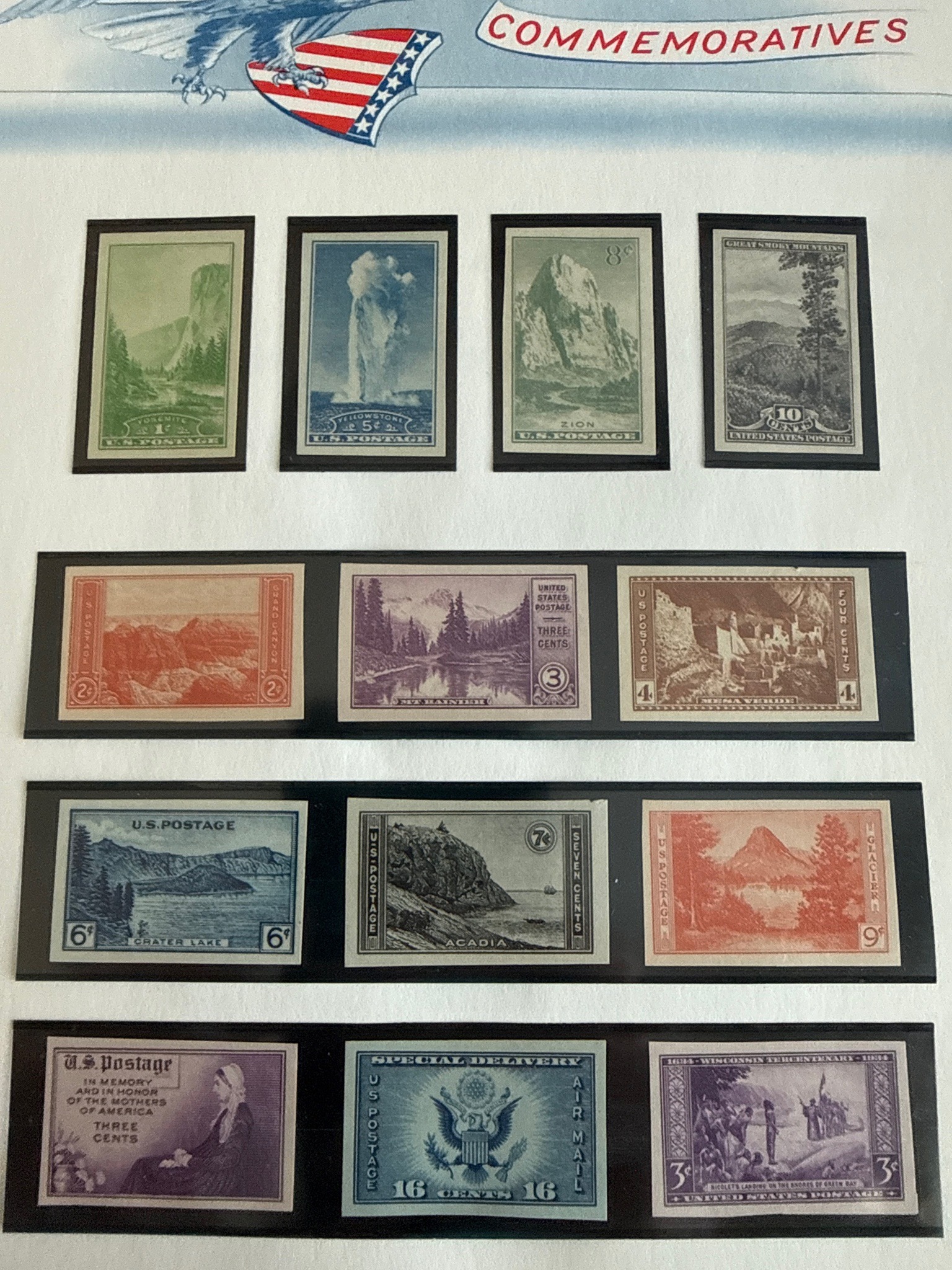
This image displays a collection of United States postage stamps mounted on a commemorative album page, featuring the prominent 1934 National Parks commemorative series alongside other historical stamps. The physical characteristics include rectangular paper stamps printed in various single-color intaglio styles, showcasing hues of green, blue, brown, purple, and red. The primary row-based presentation displays distinct scenery and subjects typical of mid-20th-century American postal issues. Notable features and markings visible on the stamps include text inscriptions such as 'U.S. POSTAGE', denomination numerals like '1C', '2C', '3C', '4C', '5C', '6C', '7C', '8C', '9C', '10C', '16C', and specific park names including 'YOSEMITE', 'YELLOWSTONE', 'ZION', 'GREAT SMOKY MOUNTAINS', 'GRAND CANYON', 'MT. RAINIER', 'MESA VERDE', 'CRATER LAKE', and 'ACADIA'. Additional bottom rows include a purple commemorative featuring a mother figure inscribed 'IN MEMORY AND IN HONOR OF THE MOTHERS OF AMERICA', a blue 'SPECIAL DELIVERY AIR MAIL' stamp with an eagle seal, and a purple 'WISCONSIN TERCENTENARY 1634-1934' stamp. The visible condition appears generally good for vintage paper collectibles, preserved securely within black stamp mounts on heavy white paper stock, though minor toning or paper aging cannot be ruled out without physical handling. The style and manufacturing details are consistent with engraved postage stamps issued by the Bureau of Engraving and Printing during the 1930s. The identification of this assemblage relies purely on the legible printed text and iconography visible on the individual stamp faces within the photograph, without any physical verification of paper watermarks, gum condition, or cancellation marks.
AI Appraisal Report
Based on the visual evidence in the photograph, I can observe a collection of United States postage stamps, most notably the 1934 National Parks commemorative series alongside other 1930s issues mounted on an album page. Based on what I can see, the printing appears consistent with mid-20th-century intaglio issues, displaying correct iconography and denominations. However, I can't verify from a photo the actual paper watermarks, gum condition, presence of hinge remnants, cancellation marks, or paper integrity, all of which heavily influence philatelic value. Assuming the stamps are hinged or lightly mounted mint/used copies in generally sound collector condition, comparable assemblages typically trade within this market range. Demand for classic U.S. commemoratives remains steady among traditional collectors, though common unused or lightly hinged 1930s stamps are generally abundant in the current market. To establish a more precise value or to confirm authenticity, physical inspection by a professional philatelist is required to check for hidden thins, regumming, reperfing, or forgery. If these pieces turn out to be modern reprints, commemorative facsimiles, or color copies rather than postal issues, the value would drop to negligible nominal or decorative levels.