AI estimate as of December 13, 2025 · verify with a professional before acting
AI-Generated · Verify before acting
Everything on this page is generated by AI for informational purposes only. AI can make mistakes — the AI may misidentify items or misattribute them (artist, maker, brand, designer, origin, era). This is not an official valuation and should not be used for insurance, sale, tax, estate, legal, or lending purposes — or any decision requiring a certified appraisal. It is not an authoritative claim about any person, brand, or rights holder — do not share or rely on it as a factual statement about a third party. Always consult qualified professionals before making financial decisions.
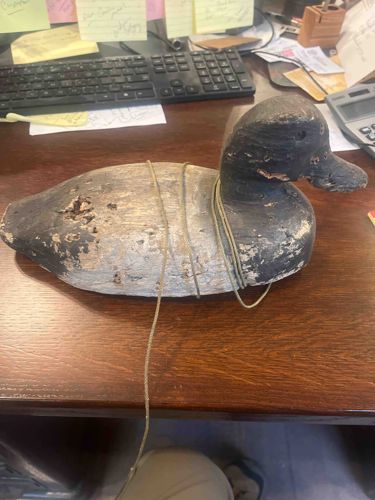
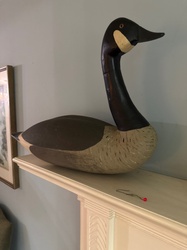
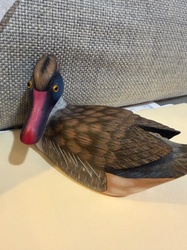
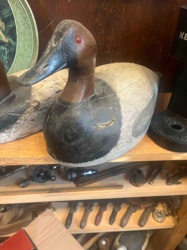
This is a vintage wooden duck decoy, likely hand-carved, exhibiting significant wear consistent with extensive use and age. The decoy depicts a duck with a dark, possibly black or very dark brown, head and neck, and a lighter, weathered gray or off-white body. The original paint is heavily distressed, flaking, and worn away in many areas, revealing the natural wood grain beneath. There are noticeable areas of pitting and small chips in the wood, particularly on the back and sides of the body, suggesting exposure to elements and impact. A light-colored, possibly nylon or natural fiber, string or rope is wrapped around its body and trails off, presumably for anchoring the decoy. The overall form is somewhat stylized but functional, with a solid body construction. The head is securely attached to the body, though the paint at the joint shows significant wear. The eyes are not clearly discernible in the image, possibly due to paint loss or simple carved depressions. Based on the degree of wear and traditional construction, it likely dates from the mid-20th century or earlier. There are no visible maker's marks or signatures. The craftsmanship appears robust, designed for durability in water, rather than intricate artistic detail, indicating its purpose as a functional hunting tool. The patina created by the weathered paint and wood adds to its aged aesthetic.
AI Appraisal Report
I have thoroughly examined the provided image of this vintage wooden duck decoy. The item presents as a hand-carved, functional hunting decoy, likely from the mid-20th century or possibly earlier, given its robust construction and significant wear. The dark head and neck, contrasting with the lighter, weathered body, suggest an original paint scheme that is now heavily distressed, revealing the underlying wood grain. The extensive paint loss, flaking, pitting, and chips are all consistent with its intended use as a working decoy exposed to the elements and impacts, which contributes to its authentic vintage character rather than detracting significantly from its value as a collectible hunting tool.
From a market perspective, comparable working decoys of this age and condition, especially without clear maker's marks, typically fall into a mid-range value. Demand for such utilitarian folk art is steady among collectors of sporting memorabilia and Americana. While not exceptionally rare, the authentic wear and patina add to its appeal. The absence of discernible eyes and the generic form suggest it was made for function over artistic detail, which is common for working decoys.
Factors significantly impacting its value include its age, clear evidence of use, and the aesthetic appeal of its distressed condition. However, the lack of a known maker or specific region of origin limits its potential for higher valuation. To fully authenticate its age, origin, and potential maker, an in-person examination would be crucial. I would look for specific carving techniques, wood type identification, and any hidden or faint maker's marks. Furthermore, provenance documentation, such as the history of ownership or photographs of it in use, would significantly enhance its value. Without these, I can only assess it on its observable physical characteristics.