AI estimate as of December 13, 2025 · verify with a professional before acting
AI-Generated · Verify before acting
Everything on this page is generated by AI for informational purposes only. AI can make mistakes — the AI may misidentify items or misattribute them (artist, maker, brand, designer, origin, era). This is not an official valuation and should not be used for insurance, sale, tax, estate, legal, or lending purposes — or any decision requiring a certified appraisal. It is not an authoritative claim about any person, brand, or rights holder — do not share or rely on it as a factual statement about a third party. Always consult qualified professionals before making financial decisions.
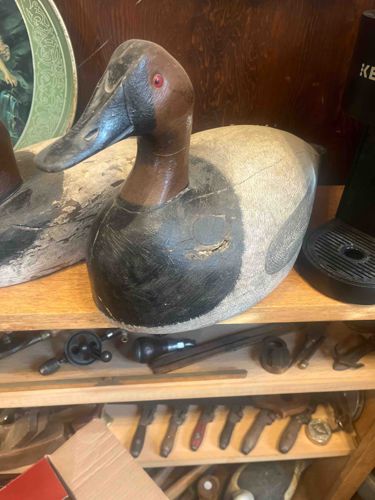
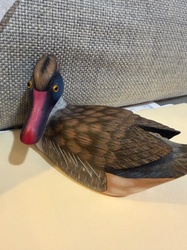
This is a vintage hand-carved duck decoy, crafted to resemble a male Canvasback duck (Aythya valisineria). The decoy features a distinct elongated head with a reddish-brown coloration, a black bill, and prominent red glass eyes. The neck is also reddish-brown, transitioning into a black chest and back. The majority of the body is painted a light gray or off-white, characteristic of a Canvasback drake, with subtle feathering details suggested by slight variations in paint tone or carving. The construction appears to be solid wood, likely pine or cedar, which was commonly used for its buoyancy and workability. The surface exhibits significant wear, consistent with considerable use in adverse outdoor conditions. Paint loss is evident across the entire piece, particularly on the chest, head, and areas of the body, revealing the darker wood beneath. There are visible cracks on the body, especially a prominent one running horizontally along the side, indicating potential drying out of the wood or impact. The once smooth surfaces are now textured from weathering and age, contributing to a rich, aged patina. The carving style suggests a utilitarian intent, typical of working decoys, with anatomical features rendered for identification by ducks rather than artistic perfection. There are no immediately discernible maker's marks or signatures from the visible angles. Based on the style and condition, it likely dates from the early to mid-20th century. The craftsmanship, while perhaps not fine art, demonstrates skilled woodworking and painting tailored for its intended purpose, reflecting the folk art tradition of decoy making. The decoy possesses a rustic charm and authenticity, indicative of a well-used and cherished hunting tool.
AI Appraisal Report
I have examined the image of this vintage hand-carved Canvasback duck decoy. Based on its utilitarian carving style, hand-painted details, and significant wear, it presents as an authentic working decoy, likely dating from the early to mid-20th century. The reddish-brown head/neck and black breast against the light gray body are characteristic of a Canvasback drake. The construction appears to be solid wood, consistent with period decoys made for buoyancy. The condition, while showing extensive paint loss, cracks, and weathering, is typical and often desirable for authentic working decoys, contributing to its rustic charm and historical narrative. This type of wear tells a story of its intended use in harsh outdoor conditions.
Market demand for vintage folk art hunting collectibles remains steady, especially for species-specific decoys like the Canvasback. Comparables for well-used, unsigned early to mid-20th century working decoys of this caliber typically range from $200-$500, with condition, maker (if identifiable), and regional origin being significant value drivers. This decoy falls into the mid-range of that spectrum due to its appealing display of age and use, despite the significant paint loss and visible cracks.
Factors impacting its value positively include its clear folk art aesthetic and likely age, while the absence of a discernible maker's mark and the extent of the deterioration (cracks) slightly temper its potential highest value. Unsigned pieces generally command less than those by known carvers, though they still hold intrinsic value as examples of traditional craftsmanship. The overall 'look' and patina are attractive to collectors of sporting art and Americana.
It is important to note that my assessment is based solely on the provided image. Full authentication would require a hands-on examination to verify wood type, construction methods, and paint layers, which could reveal touch-ups or repairs not visible in photographs. Provenance documentation, such as the decoy's history of ownership or regional origin, would also be invaluable in confirming its authenticity and potentially enhancing its value beyond this visual appraisal.