AI estimate as of November 2, 2025 · verify with a professional before acting
AI-Generated · Verify before acting
Everything on this page is generated by AI for informational purposes only. AI can make mistakes — the AI may misidentify items or misattribute them (artist, maker, brand, designer, origin, era). This is not an official valuation and should not be used for insurance, sale, tax, estate, legal, or lending purposes — or any decision requiring a certified appraisal. It is not an authoritative claim about any person, brand, or rights holder — do not share or rely on it as a factual statement about a third party. Always consult qualified professionals before making financial decisions.
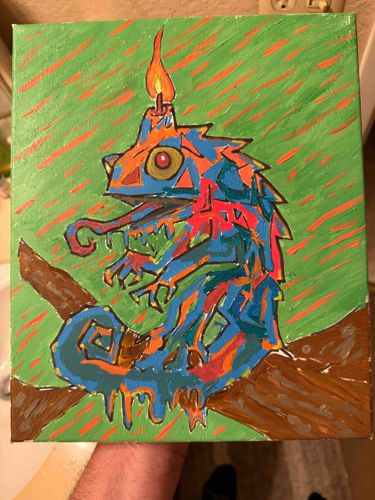
This item is an acrylic painting on canvas, depicting a stylized and somewhat whimsical chameleon. The artwork measures approximately 8x10 inches, based on the visible hand holding it, suggesting a common small canvas size. The central figure is a chameleon, rendered with vibrant and contrasting colors: a primary blue body with bold orange and red abstract patterns overlaying it, creating a segmented or fragmented appearance. Its skin also shows dripping elements, particularly around the lower body and snout, suggesting molten wax, which ties into the most distinguishing feature: a lit candle fused to the top of its head, complete with a flickering orange and yellow flame. The chameleon has prominent, wide-set yellow eyes with dark pupils, and its tongue is extended and curled. It is perched on a dark brown branch, which spans across the bottom of the canvas. The background is a bright, almost neon, green, streaked with diagonal orange lines, adding to the dynamic and surreal quality of the piece. The paint application appears to be thick and impasto in some areas, particularly noticeable in the dripping wax effect and the flame. The brushwork has a slightly unrefined, expressive quality, consistent with a folk art or outsider art aesthetic. There are no visible artist's signatures, dates, or manufacturer's marks from the provided image. The overall condition appears good, with no obvious signs of damage, tears, or repairs to the canvas or paint layer. The style suggests a modern, possibly contemporary, folk art or street art influence, with a playful yet slightly macabre thematic element due to the melting candle.
AI Appraisal Report
Upon visual examination of the provided image, this acrylic painting on canvas, featuring a 'Surreal Chameleon Candle,' appears to be in good overall condition. There are no visible signs of damage, tears, or repairs to the canvas or paint layer. The impasto technique, particularly in the 'dripping wax' effects and flame, seems well-preserved. Authenticity, based solely on this image, is limited; without a visible signature or any provenance documentation, I cannot definitively attribute it to a specific artist or verify its origin. The style strongly suggests a modern folk art or outsider art aesthetic, possibly with street art influences, characterized by its vibrant colors, whimsical subject matter, and expressive brushwork.
Market conditions for unsigned folk art pieces of this scale (estimated 8x10 inches) are generally moderate. Comparables in the contemporary folk art market often range from $100 to $400 for unsigned works by lesser-known artists, with factors like originality, visual impact, and condition influencing the upper end. The unique and surreal imagery of the chameleon with a melting candle on its head is a strong point, offering a distinctive appeal. However, the lack of an identifiable artist signficantly impacts its value, limiting it to a decorative art price point rather than a fine art investment.
Demand for unique, smaller-scale folk art like this is consistent among collectors seeking decorative or conversation-starting pieces, but it is not considered rare in a broader art market context. The most significant factor impacting value is the absence of an artist's signature or any documented provenance. To fully authenticate and potentially increase its value, an in-person examination would be crucial to assess paint quality, canvas age, and any subtle identifying marks. Further research into similar styles or artist communities would also be beneficial to establish a clearer lineage for the piece.