AI estimate as of November 26, 2025 · verify with a professional before acting
AI-Generated · Verify before acting
Everything on this page is generated by AI for informational purposes only. AI can make mistakes — the AI may misidentify items or misattribute them (artist, maker, brand, designer, origin, era). This is not an official valuation and should not be used for insurance, sale, tax, estate, legal, or lending purposes — or any decision requiring a certified appraisal. It is not an authoritative claim about any person, brand, or rights holder — do not share or rely on it as a factual statement about a third party. Always consult qualified professionals before making financial decisions.
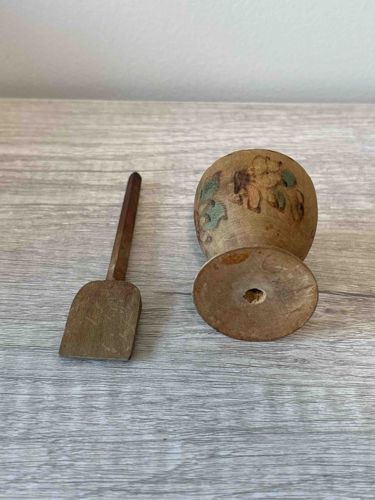
This item is a vintage mortar and pestle set, likely used for grinding spices, herbs, or medication. The set comprises two distinct pieces, both crafted from wood. The mortar, which is the larger, cup-shaped component, exhibits a roughly spherical body with a flatter, circular base, suggesting it was turned on a lathe. Its exterior is adorned with what appears to be hand-painted floral or foliate motifs in muted green and brown tones, indicative of an older decorative style. The paint shows significant signs of wear and fading, with much of the original design lost or obscured, giving it a well-used, aged patina. The pestle is a slender, elongated tool with a handle that tapers down to a broader, flat-ended working surface. It appears to be made from a darker wood than the mortar, or perhaps has acquired a deeper patina from use. Both pieces show considerable wear consistent with age and frequent use, including scuffs, scratches, and a generally darkened, aged appearance. There is a notable circular indentation or hole in the center of the mortar's base, which could be a remnant from the manufacturing process (e.g., where it was mounted on a lathe) or a structural detail. The craftsmanship suggests a rustic or utilitarian application, possibly dating from the early to mid-20th century. The wood grain is visible in areas where the paint has worn off, indicating a solid wood construction rather than veneer. The condition suggests no recent repairs, and the wear is consistent with authentic vintage use rather than intentional distressing. The overall aesthetic points to a folk art or farmhouse style.
AI Appraisal Report
I have examined the Vintage Wooden Mortar and Pestle Set with Floral Decoration. Based on the provided image, the set appears authentic to its described age and purpose. The significant wear, faded hand-painted floral motifs, and darkened patina are consistent with an item of folk art or farmhouse style from the early to mid-20th century. The visible wood grain beneath the worn paint confirms solid wood construction. There are no signs of recent repairs or intentional distressing, indicating genuine age and use.
Market conditions for vintage kitchenware, especially utilitarian wooden items, are generally stable but not highly speculative. Comparables for similar hand-painted wooden mortar and pestle sets of this vintage often range from $30 to $80, depending on the intricacy of the decoration and overall condition. The demand for such items typically comes from collectors of primitive tools, folk art enthusiasts, or individuals seeking rustic decor.
Factors impacting value include the charming, albeit worn, floral decoration, the evident age, and the completeness of the set. The visible wear, while authentic, also limits the top-end value as collectors often prefer items with more intact decoration. Rarity is moderate; similar wooden sets appear periodically in various regional styles.
It is important to note that my assessment of authenticity and condition is based solely on visual examination of the image. For full authentication, an in-person examination would be crucial to assess wood type, paint composition, and manufacturing techniques more accurately. Physical inspection could also verify the depth and nature of the wear. Provenance documentation, though less common for utilitarian items, would solidify the historical context. Scientific testing for wood dating or paint analysis would provide definitive age determination but is rarely pursued for items in this value range.