AI estimate as of September 12, 2025 · verify with a professional before acting
AI-Generated · Verify before acting
Everything on this page is generated by AI for informational purposes only. AI can make mistakes — the AI may misidentify items or misattribute them (artist, maker, brand, designer, origin, era). This is not an official valuation and should not be used for insurance, sale, tax, estate, legal, or lending purposes — or any decision requiring a certified appraisal. It is not an authoritative claim about any person, brand, or rights holder — do not share or rely on it as a factual statement about a third party. Always consult qualified professionals before making financial decisions.
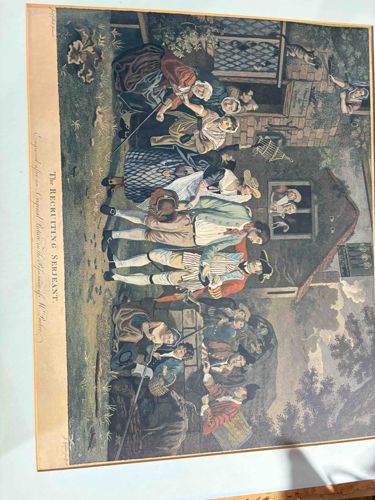
This item is a framed, probably copperplate, engraving titled "The Recruiting Sergeant," which appears to be a reproduction or based on a work by William Hogarth, as indicated by the faint text "Invented & painted by William Hogarth" visible on the lower left margin. The print depicts a bustling outdoor scene with numerous figures characteristic of Hogarth's narrative and satirical style. The central figures include a sergeant in a red coat and white breeches, likely recruiting, surrounded by various individuals, including women and other men, some seemingly inebriated or being conscripted. The composition is dynamic, with multiple focal points and interacting characters, including a dog in the upper right. The colors are muted, presenting a pastel palette dominated by blues, reds, browns, and greens, typical of 18th-century engravings that might have been hand-colored. The print exhibits signs of age, including some discoloration and foxing, particularly visible in the margins and possibly across the image itself, suggesting an older piece. The paper appears to be thick, with some subtle texture. The framing consists of a simple, narrow wooden frame or possibly a matboard, with the print mounted behind glass. The overall condition suggests a vintage or antique item, with visible wear consistent with its age, but no apparent major tears or severe damage. The craftsmanship of the engraving itself appears fine, with detailed lines articulating the figures and architectural elements.
AI Appraisal Report
Upon examining the provided image of “The Recruiting Sergeant,” I observe a vintage or antique engraving, likely a copperplate, attributed to William Hogarth. The faint text "Invented & painted by William Hogarth" suggests it is either a contemporary print of his work, or a later reproduction. The condition shows visible signs of age, including discoloration, foxing, and surface wear—all consistent with an older paper item. While the engraving itself appears competently executed with good detail, the general condition is Fair to Good, indicating it has not been perfectly preserved.
Assessing authenticity purely from an image is challenging. While it is undoubtedly a print after Hogarth, determining if it’s an original 18th-century pull, a later 19th-century restrike, or a more recent reproduction without physical examination is impossible. Authenticity would require verifying paper type, watermarks, plate marks, and print quality under magnification. Provenance documentation, such as collection history or dealer receipts, would also be critical.
For market conditions, comparable 18th-century Hogarth prints in good condition, and particularly first or early states, can command higher values. However, later impressions or reproductions are significantly less valuable. Given the condition and the uncertainty regarding its age and originality as an 18th-century print versus a later restrike, I’ve considered market demand for decorative period engravings. Without definitive proof of its early impression status, its value is significantly impacted.
This piece has decorative appeal and historical interest, but its condition and the high probability of it being a later impression (which is common for popular Hogarth works) limit its market value. An in-person inspection would be crucial to confirm paper characteristics, printing technique, and true age, which could either significantly increase or decrease this preliminary valuation.