AI Appraisal Estimate

AI-generated estimates · not official valuations

From the user

What was submitted

Photo and notes provided by the user — not generated by AI

Submitted item photo
Submitted photo · May 23, 2026

User's notes

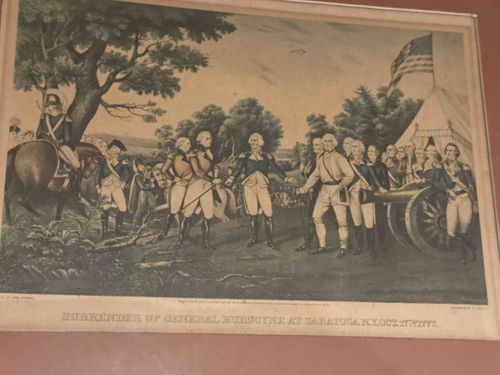
Engraving surrender of general Burgoyne at Saratoga, New York, October 17, 1777

AI analysis below

AI appraisal

AI analysis & estimate

AI-Generated · Verify before acting

Everything below is generated by AI for informational purposes only. AI can make mistakes — the AI may misidentify items or misattribute them (artist, maker, brand, designer, origin, era). This is not an official valuation and should not be used for insurance, sale, tax, estate, legal, or lending purposes — or any decision requiring a certified appraisal. It is not an authoritative claim about any person, brand, or rights holder — do not share or rely on it as a factual statement about a third party. Always consult qualified professionals before making financial decisions.

Note

This analysis also relies on unverified notes provided by the user, which may be incomplete or inaccurate and could affect the result.

Read the full disclaimer

AI Identification

·Not independently authenticated·Verify before acting

Surrender of General Burgoyne at Saratoga, N.Y. Oct. 17th, 1777 (Lithograph)

Historical Prints and Engravings

AI Estimated Value

·Not an official valuation·Verify before acting

$40 - $80

As of May 23, 2026

AI Item Analysis

·AI can make mistakes·Verify before acting
This item is a 19th-century tinted lithograph depicting the historic surrender of British General John Burgoyne to American General Horatio Gates during the American Revolutionary War. The composition is based on the famous large-scale oil painting by John Trumbull. The central focal point shows the exchange of a sword between the opposing generals under a large tree, surrounded by staff officers, a mounted soldier on the left, and a field cannon and military tent with a flying American flag on the right. The color palette consists of muted earth tones, blues, and tans consistent with hand-tinted or chromolithographic processes of the mid-to-late 1800s. The artwork includes a wide lower margin containing a printed title in a serif typeface. Physically, the paper displays significant amber-colored foxing and overall yellowing, likely due to acidic contact or long-term UV exposure. There is visible moisture staining and darkening along the bottom edge and corners. The print appears to be housed in an older frame, suggesting it may have been displayed for many decades. While the exact publisher's mark is partially obscured in the image, the style strongly resembles the historical prints produced by firms like Currier & Ives or Kellogg in the late 19th century.
AI Appraisal Report

·AI can make mistakes·Verify before acting
Based on my examination of the image provided, this is a 19th-century hand-colored lithograph titled 'Surrender of General Burgoyne at Saratoga, N.Y. Oct. 17th, 1777.' While the composition is derived from John Trumbull's famous painting, this particular print appears to be a mass-produced version by a firm such as N. Currier (Currier & Ives) or perhaps Baillie, rather than a fine steel engraving. The coloring and lithographic texture are consistent with mid-to-late 19th-century commercial prints. Unfortunately, the condition drastically impacts the value. The paper exhibits severe acidification, evidenced by the deep yellow-amber toning throughout. There is significant foxing (reddish-brown spotting) across the sky and figures, and heavy water staining is visible along the bottom margin. This level of deterioration is irreversible and greatly diminishes its aesthetic appeal. In the market, pristine examples of similar small-folio historical lithographs from known publishers might fetch $150–$250. However, in this compromised state, it holds primarily decorative or historical curiosity value rather than investment potential. Demand for Revolutionary War subject matter remains steady, but collectors prioritize condition above almost all else. To provide a definitive authentication, I would need to inspect the paper physically to confirm it is wove paper typical of the period and to identify any publisher's lines obscured by the matting or staining. An in-person inspection would also determine if the print has been laid down (glued) to a backing board, which would further reduce its conservation potential.

Get your items appraised

Instant estimates of your treasures with AI-powered appraisals

Browse More Appraisals